
Service
Architecture Review & Assurance
Independently review existing architectures, transformation plans and major technical decisions before implementation.


Validate the architecture before committing to it
Major technology decisions often look reasonable on a diagram but become much harder to change once contracts are signed, data is moved and production systems depend on them.
We independently review architectures, transformation plans and critical technical decisions to identify hidden risks, weak assumptions and missing operational considerations before implementation moves too far.
Typical scenarios:
A major architecture is ready for approval – leadership wants an independent view before committing budget or starting implementation.
A vendor has proposed the target solution – the organization needs to understand the trade-offs beyond the vendor’s preferred platform.
A transformation plan looks good on paper – but dependencies, operations, security or cutover assumptions have not been tested deeply enough.
Several teams disagree on the technical direction – an evidence-based review is needed to separate real risk from architecture preference.
How does Architecture Review & Assurance work?
We examine the proposed architecture, requirements and assumptions, test them against real business and operational constraints, and turn the findings into clear decisions and prioritized actions.
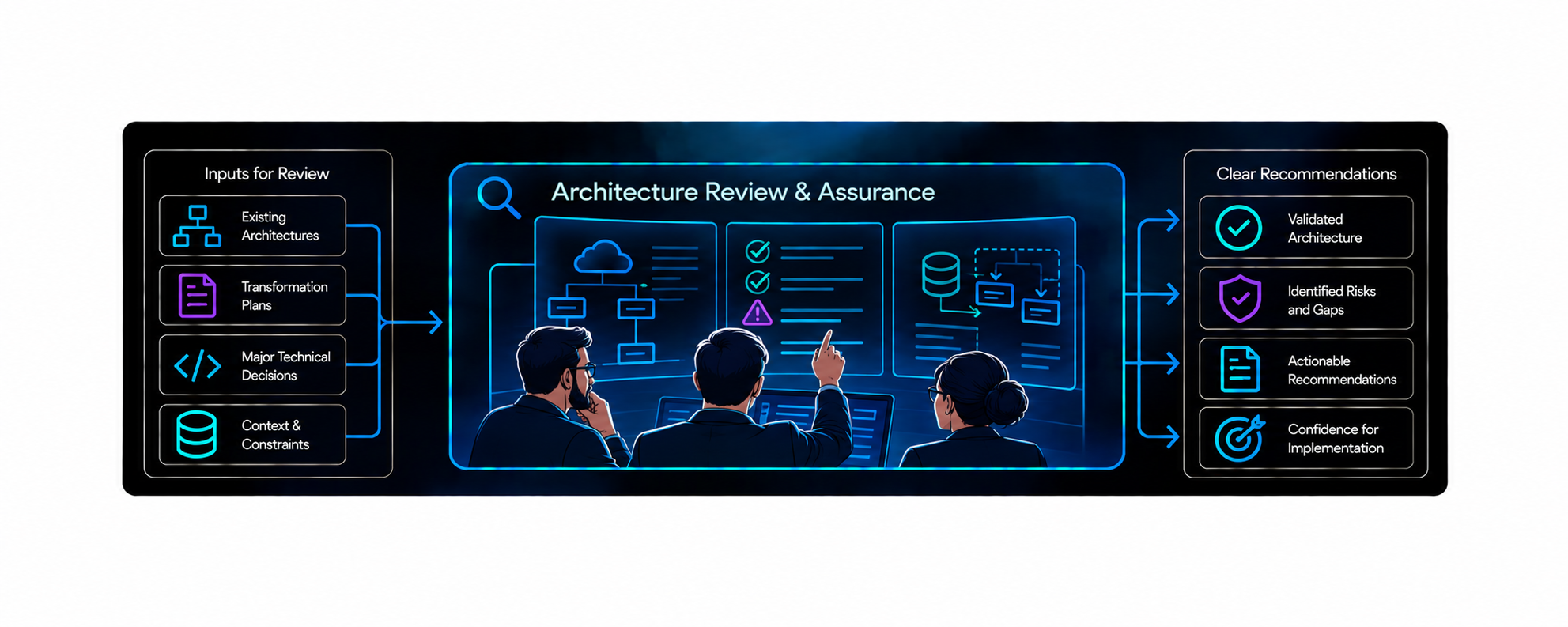
What does an architecture review include?
A useful architecture review does more than compare diagrams with a checklist. It looks at how the design will behave in production, what it depends on and whether important trade-offs have been made consciously.

Find the problems while they are still cheap to change
An architecture review creates the most value before implementation removes your options.
We focus on decisions with meaningful consequences: architecture boundaries, workload placement, resilience, data movement, security, operating responsibility and platform commitments.
Not every finding requires redesign. The goal is to separate acceptable trade-offs from risks that need action before the next decision gate.
We provide:
Independent architecture and design review
Risk, dependency and assumption analysis
Decision and remediation recommendations
Implementation and go-live assurance

Benefits of Architecture Review & Assurance
Frequently Asked Questions
What is an architecture review?
An architecture review is a structured examination of an existing or proposed technical design.
It looks at whether the architecture can meet its functional and operational requirements and examines areas such as reliability, security, performance, cost, dependencies and supportability.
The objective is not to redesign everything.
It is to identify significant risks, confirm important assumptions and make the consequences of the proposed design clear before implementation continues.
AWS describes architecture review as a constructive process for identifying critical issues and improvement areas rather than an audit.
When should we perform an architecture review?
The best time is before a major decision becomes expensive to reverse.
Common points include:
- before approving a target architecture,
- before signing a major platform or vendor commitment,
- before starting a migration or modernization program,
- before a major production launch,
- before a high-risk cutover,
- after significant architecture change.
AWS recommends reviewing early in design, before go-live and again when significant architecture changes occur.
Can you review an architecture designed by another consultancy or vendor?
Yes.
This is one of the strongest use cases for independent assurance.
We can examine a proposed architecture without assuming the original design is wrong. The review focuses on requirements, evidence and trade-offs.
Where a hyperscaler, software vendor or implementation partner has proposed the target, we pay particular attention to assumptions around lock-in, operating complexity, cost, portability and whether alternative patterns were considered.
The objective is not to create conflict with the delivery partner. It is to make sure the organization understands what it is committing to.
Which architecture standards do you use?
We do not apply one framework mechanically to every environment.
Depending on the workload, we can use relevant principles from AWS, Azure and Google Well-Architected frameworks, common security and resilience practices, internal architecture standards and the customer’s own technical requirements.
Microsoft’s current Well-Architected Review evaluates architecture across reliability, security, cost optimization, operational excellence and performance efficiency. Google uses comparable pillars and also supports hybrid and multi-cloud environments.
The framework helps structure the review. The workload context determines the decision.
What information do you need for the review?
Useful inputs normally include:
- architecture and network diagrams,
- business and non-functional requirements,
- architecture decision records,
- workload and dependency information,
- security requirements,
- availability and recovery targets,
- cost or capacity assumptions,
- migration or implementation plans,
- operational and support models.
We then validate important areas with the architects, engineers, security teams, operations and business owners involved.
AWS specifically recommends establishing workload ownership, purpose, boundaries, dependencies and business outcomes before running a review.
Do you review transformation and migration plans as well as architecture?
Yes.
A target architecture can be technically sound while the transformation plan is not executable.
We therefore look at areas such as migration sequence, coexistence, dependency handling, testing, data movement, rollback, operational readiness and ownership where they are relevant to the engagement.
This is especially important for migrations and modernization programs because architecture risk often appears at the transition between the current and target states rather than inside the target-state diagram itself.
Is Architecture Review & Assurance an audit?
No.
It is a technical assurance activity, not a formal compliance certification or audit unless that scope is explicitly agreed with a qualified audit partner.
The review can identify technical gaps related to security, resilience or governance requirements and provide evidence or remediation recommendations.
But the purpose is to improve the architecture and decision quality.
AWS also explicitly states that its Well-Architected review process is a conversation about architecture decisions, not an audit mechanism.
What do we receive after the review?
The exact output depends on the scope, but typically includes:
- architecture findings,
- risk and assumption register,
- prioritized recommendations,
- required decision points,
- remediation actions,
- architecture decision updates,
- readiness or implementation concerns,
- executive summary for leadership.
For larger transformations, we can remain involved through design checkpoints, implementation assurance or go-live review.
The important point is that findings have owners and consequences.
Architecture Decision Records can also be useful for capturing major decisions, their context and their implications so teams understand later why a particular direction was chosen.
Turn your Technology Challenge into a clear Delivery Plan
Nubes Consulting Digital helps design, modernize and operate complex technology environments. From Cloud and Architecture to DevOps, SRE and Engineering Delivery, we focus on practical decisions, reliable execution and measurable business outcomes.
