
Service
Delivery Leadership & Governance
Strengthen complex programs with technical leadership, architecture governance, risk control and cross-team coordination.


Keep complex programs moving in one technical direction
Large technology programs become difficult when several teams, vendors and technical domains have to deliver together, but decisions and responsibilities are spread across the organization.
We provide senior technical delivery leadership that connects architecture, program execution, risk and cross-team coordination so important decisions are made, blockers are escalated and delivery remains aligned with the intended outcome.
Typical scenarios:
Several teams are delivering one transformation – but dependencies and responsibilities are not clear enough between them.
Important decisions stay open too long – architecture, security or operational questions move between meetings without a clear owner.
The program is busy but progress is difficult to see – activity is high while critical milestones, risks and dependencies keep slipping.
Multiple vendors need stronger client-side leadership – no single delivery partner has responsibility for the complete technical outcome.
How do Delivery Leadership & Governance work?
We establish clear decision rights, technical governance and delivery controls across the program, then stay involved to resolve cross-team issues, manage technical risk and keep execution aligned with architecture and business priorities.
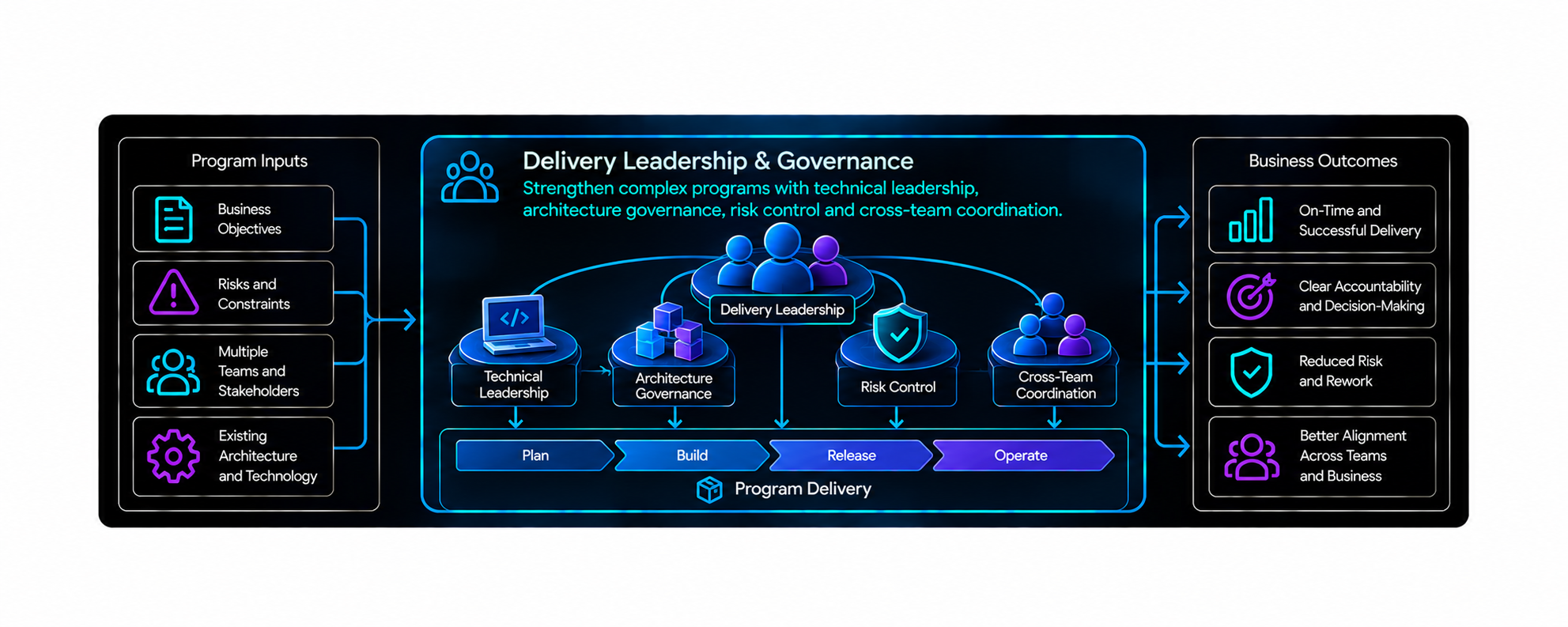
What does Delivery Leadership & Governance include?
Complex delivery needs more than status reporting. It needs a clear mechanism for deciding, escalating and coordinating work when one team’s decision affects another team’s architecture, timeline or production risk.

Govern the decisions, not every task
Good governance should remove uncertainty from delivery, not create more meetings.
We focus senior attention on decisions, dependencies and risks that can change the program outcome. Routine delivery stays with the teams closest to the work, while cross-program issues have clear owners and escalation paths.
The result is tighter control where it matters without turning technical delivery into a central approval process.
We provide:
Technical leadership and decision governance
Cross-team dependency and risk management
Architecture and delivery readiness gates
Executive reporting and escalation support

Benefits of Delivery Leadership & Governance
Have many teams working, but nobody owning the complete technical outcome?

Frequently Asked Questions
What is Delivery Leadership & Governance?
Delivery Leadership & Governance provides senior technical control across a complex program.
It connects architecture, engineering delivery, risks, dependencies and executive decisions.
The role can include technical leadership, architecture governance, cross-team coordination, readiness reviews, risk escalation and communication with sponsors.
The goal is not to replace every project manager or engineering lead. It is to make sure the complete program can make decisions and deliver as one system.
How is this different from a PMO?
A PMO normally focuses strongly on areas such as schedule, budget, reporting, resources and project process.
Our Delivery Leadership & Governance service adds the technical decision layer.
We work directly with architects, engineering leads and delivery teams on dependencies, architecture choices, operational readiness and technical risks.
The two functions can work together.
AWS large-program guidance makes this distinction visible by combining project governance with architecture, portfolio, infrastructure, operations and migration workstreams rather than expecting project management alone to solve technical coordination.
What types of programs need this service?
It is most useful where delivery crosses several teams or organizations.
Examples include:
- large cloud migrations,
- legacy modernization,
- platform transformations,
- data-center exits,
- mergers and carve-outs,
- multi-vendor programs,
- regulated technology changes,
- major application and infrastructure transformations.
The common factor is dependency.
If one team can deliver the full outcome independently, heavy program governance is normally unnecessary.
How do you define who can make which decisions?
We establish decision rights early.
Some decisions belong with individual delivery teams. Others affect shared architecture, security, cost, resilience or the whole program and need wider ownership.
Tools such as a RACI can help make responsibilities explicit, but we also define escalation and decision deadlines so the matrix does not become documentation nobody uses.
Microsoft recommends clearly defining governance authority, scope and relationships between teams and using RACI where useful to clarify responsibility and accountability.
How do you manage technical risks and blockers?
We maintain a visible view of material risks, assumptions, issues and dependencies and assign clear owners.
The important part is not just creating a RAID register.
Each significant item needs an expected action, decision or escalation path.
Where risk affects an important milestone, migration wave or production cutover, we use readiness criteria so the program can make a conscious go, remediate, delay or change scope decision.
PMI’s program governance guidance similarly emphasizes formal escalation policies so risks are handled at the right authority level rather than remaining unresolved inside delivery teams.
What are delivery or readiness gates?
A readiness gate is a defined checkpoint before the program enters a higher-risk stage.
For example, before a production migration we may check:
- dependencies confirmed,
- architecture approved,
- testing complete,
- monitoring ready,
- operational ownership agreed,
- rollback tested,
- unresolved risks accepted by the correct owner.
The purpose is not to add paperwork.
It is to prevent the organization from discovering missing prerequisites during the cutover itself.
AWS specifically recommends quality gates for migration and cutover as part of its large-program governance model.
How do you keep architecture governance from slowing delivery?
We govern only decisions that need wider coordination.
Teams should remain free to make local and reversible technical decisions within agreed principles.
Architecture governance should focus on decisions with consequences across teams, shared platforms, security, resilience or long-term technology direction.
We also use lightweight Architecture Decision Records where useful. Martin Fowler describes ADRs as short records of the decision, context and consequences, and notes that writing them can expose different views early enough for teams to resolve them.
Can you work alongside our existing implementation partners?
Yes.
This is a common model.
The implementation partners remain responsible for their delivery scope, while we can provide senior client-side architecture and delivery leadership across the complete program.
That can include aligning workstreams, challenging assumptions, managing cross-vendor dependencies, reviewing readiness and escalating decisions that no single supplier can resolve.
Your published three-data-center migration is strong proof for this type of role. The program involved several parallel migration teams, while you worked both as a Lead Infrastructure Architect for one team and as part of the central architecture function, aligning migration patterns and technical decisions with business risk, timelines and operational stability.
Turn your Technology Challenge into a clear Delivery Plan
Nubes Consulting Digital helps design, modernize and operate complex technology environments. From Cloud and Architecture to DevOps, SRE and Engineering Delivery, we focus on practical decisions, reliable execution and measurable business outcomes.