
Service
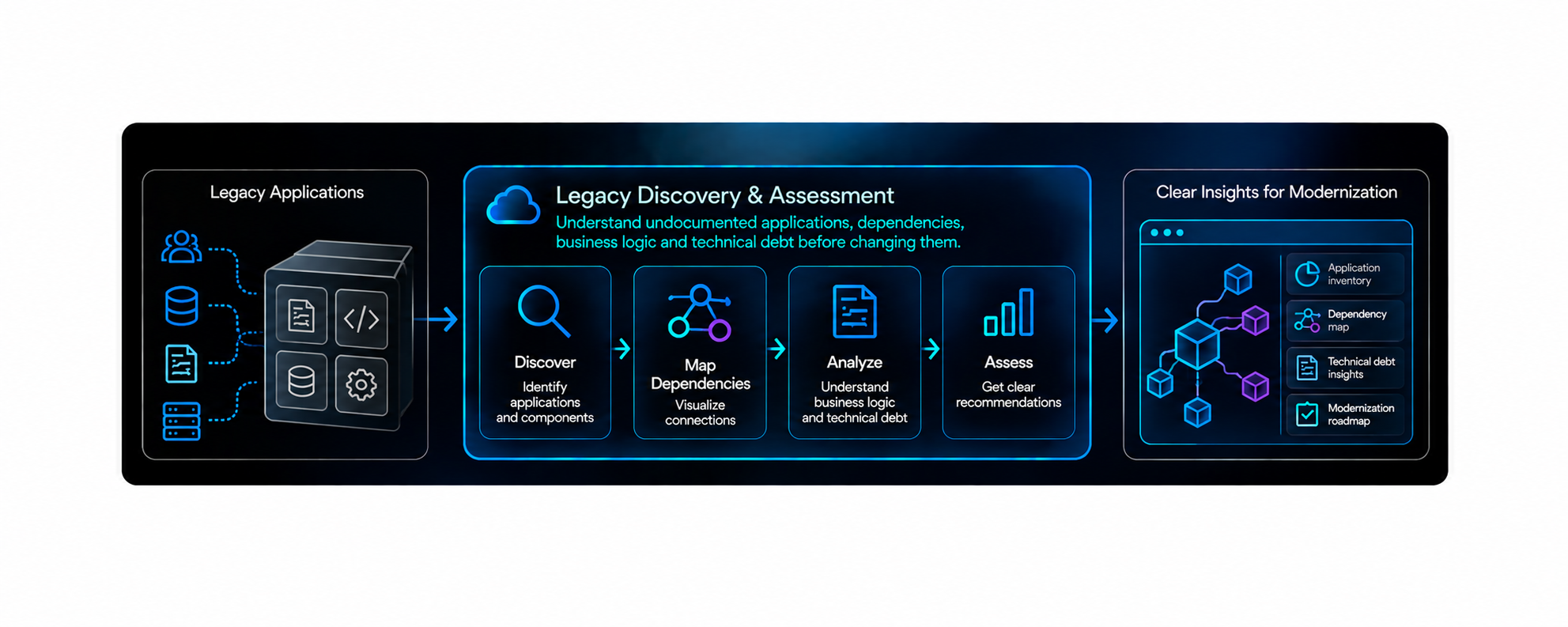
Legacy Discovery & Assessment
Understand undocumented applications, dependencies, business logic and technical debt before changing them.


Understand the legacy system before changing it
Modernization becomes risky when architecture diagrams are outdated, business rules live only in code and critical dependencies are known by only a few people.
We help you reconstruct how legacy applications actually work, identify technical debt and hidden dependencies, and build the evidence needed to decide what should be retained, refactored, replatformed, replaced or retired.
Typical scenarios:
Documentation no longer matches reality – code and production behaviour have moved far beyond the original design.
Key system knowledge is disappearing – important decisions depend on a small number of experienced people.
Modernization scope is unclear – teams cannot estimate work because dependencies and business rules are not visible.
A critical application is difficult to change – nobody wants to touch parts of the system because the impact is unpredictable.
How does Legacy Discovery & Assessment work?
We combine code and dependency analysis, runtime evidence, system documentation and expert interviews to build a practical view of the application before modernization decisions are made.
What does legacy discovery include?
Legacy discovery creates a reliable picture of how an application is structured, what it depends on and where important business behaviour lives. The goal is not perfect documentation. It is enough evidence to make modernization decisions with much less uncertainty.

From “the code is the documentation” to a modernization decision
Automated tools can discover code relationships quickly, but they do not know why the business behaves the way it does.
We combine automated analysis with runtime evidence and people who understand the system, then validate important findings before they become architecture decisions.
The result is not another inventory. It is a map of where change is possible and where more evidence is needed.
We provide:
Application and dependency maps
Business-rule and interface discovery
Technical-debt and risk assessment
Modernization options and roadmap

Benefits of Legacy Discovery & Assessment
Frequently Asked Questions
What is a legacy application assessment?
A legacy application assessment creates a structured view of the application’s business value, architecture, code, data, integrations, technical debt and operational constraints.
It helps answer practical questions such as:
Should the application stay as it is?
Should parts be refactored?
Can it be replatformed?
Should it be replaced?
Which components should modernize first?
The assessment should reduce uncertainty before a larger modernization investment is approved.
What information do you need to start?
We start with what already exists.
Useful inputs can include source repositories, architecture diagrams, application inventories, database schemas, interface documentation, monitoring data, incident history, CI/CD configuration and interviews with application owners.
Incomplete documentation is normal. The purpose of discovery is to find the gaps rather than expect the client to solve them before the engagement begins.
Microsoft similarly recommends starting modernization with an inventory covering applications, databases and infrastructure across the existing estate. Microsoft Learn
How do you find dependencies in undocumented applications?
We combine several forms of evidence.
Static analysis can identify code-level references and call relationships. Repository and configuration analysis can reveal libraries and integrations. Runtime telemetry can show which paths are actually used in production. Interviews help explain dependencies that tools cannot understand.
For infrastructure and migration assessments, AWS also recommends automated dependency mapping because configuration and application relationships are difficult to reconstruct reliably from documentation alone.
How do you discover business logic hidden in code?
We trace important workflows through source code, database logic, integrations and batch processes and connect those findings with input from system owners.
AI-assisted tools can help explain code and locate potential rules faster, especially in large or unfamiliar systems.
But generated explanations should not automatically become the source of truth.
Microsoft’s current guidance on AI-assisted modernization makes the same point: AI can help reconstruct execution paths, dependencies and documentation, but its output should initially be treated as hypotheses that need further validation.
Can AI accelerate legacy discovery?
Yes, when it is used for bounded tasks.
Current tools can help analyze codebases, explain components, identify dependencies and produce modernization assessments. Google’s App Modernization Assessment, for example, analyzes source code to identify architecture, dependencies and potential transformation blockers. AWS Transform now provides application discovery, dependency mapping and transformation planning capabilities.
We use AI where it improves coverage or speed, but important architecture and business conclusions still need deterministic evidence and human review.
What is technical debt, and how do you assess it?
Technical debt is not simply old code.
We look for conditions that make the application more expensive, risky or difficult to change, such as unsupported frameworks, duplicated logic, weak test coverage, fragile integrations, tightly coupled modules, manual deployment or difficult operational support.
We then prioritize technical debt according to its business and engineering impact rather than producing a long list of code-quality findings.
AWS modernization assessments similarly evaluate applications through business, functional, technical, financial and readiness lenses instead of treating technical debt as an isolated code metric. AWS Documentation
Does the assessment tell us how the application should be modernized?
Yes.
The purpose of discovery is to support a decision.
Depending on what we find, different parts of the application may be suitable for retaining, replatforming, refactoring, re-architecting, replacing or retiring.
The result can then feed into services such as Application Refactoring & Re-architecture, Monolith to Microservices, Database Modernization or API & Integration Modernization.
Google also recommends starting modernization with an assessment of business value and technical health before choosing the transformation approach.
What do we receive at the end of the assessment?
The exact outputs depend on the application and scope, but typically include:
- application and component map,
- dependency and integration view,
- business-rule catalogue,
- technical-debt and risk findings,
- modernization candidates,
- target-state options,
- prioritized modernization roadmap.
For important systems, we can also recommend a bounded proof of concept before the organization commits to a larger transformation.
AWS recommends essentially the same progression: assessment → modernization roadmap → target blueprint → proof of concept for selected applications.
Turn your Technology Challenge into a clear Delivery Plan
Nubes Consulting Digital helps design, modernize and operate complex technology environments. From Cloud and Architecture to DevOps, SRE and Engineering Delivery, we focus on practical decisions, reliable execution and measurable business outcomes.
