
Service
Platform Engineering
Build internal developer platforms and reusable self-service capabilities that reduce engineering friction.


Give engineering teams a faster path from code to production
Modern software teams depend on cloud infrastructure, CI/CD, security, observability and many other tools just to deliver one application.
We build internal developer platforms that turn these capabilities into reusable self-service workflows, so developers can create, deploy and operate services without rebuilding the same engineering foundation for every project.
Typical scenarios:
Every team builds its own delivery stack – pipelines, infrastructure and monitoring differ from project to project.
Developers wait for infrastructure teams – routine environments, databases or access still require tickets and manual work.
Cloud-native complexity is growing – teams spend more time understanding infrastructure than delivering product features.
DevOps standards exist but adoption is inconsistent – documentation describes the preferred way, but using it still takes too much effort.
How does Platform Engineering work?
We turn common infrastructure, delivery, security and operational practices into supported self-service capabilities that development teams can consume through clear and reusable interfaces.
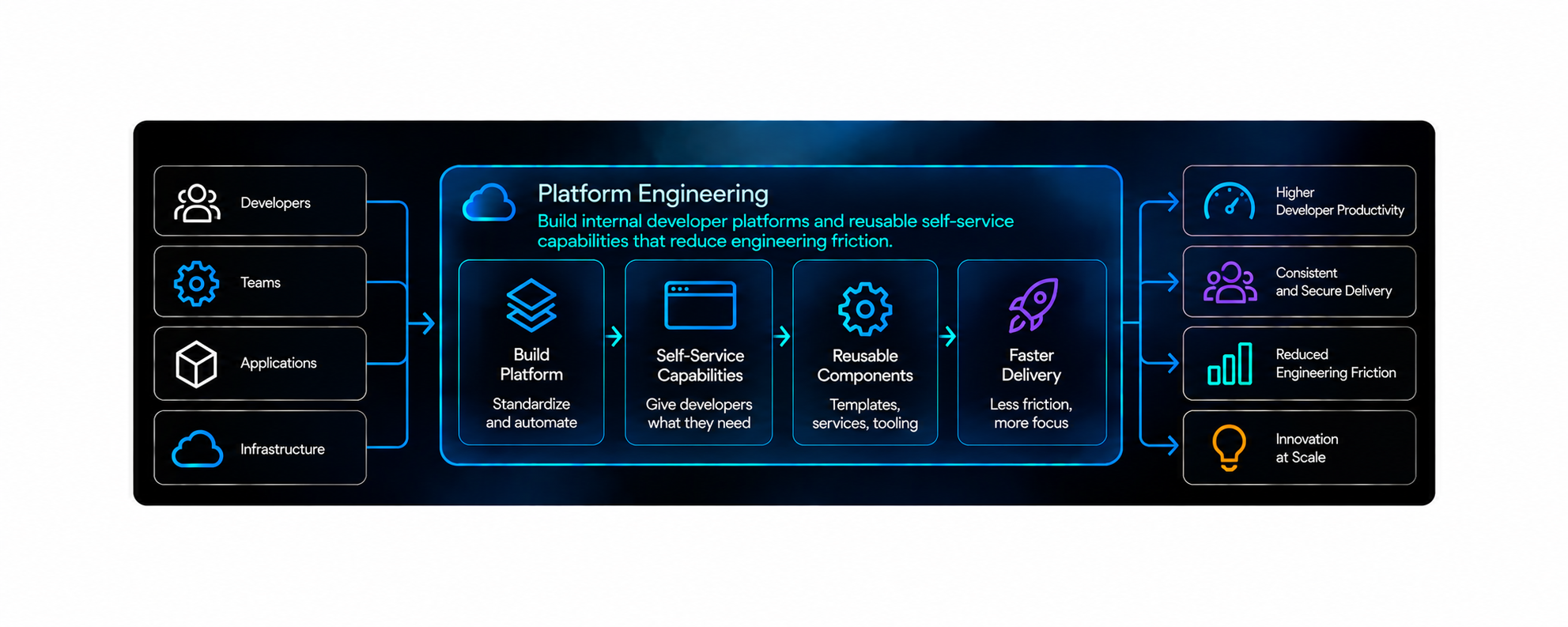
What does an Internal Developer Platform include?
An internal developer platform brings together the tools, automation and standards developers need to build and run software. It hides unnecessary complexity while keeping the controls, flexibility and operational visibility required by the organization.
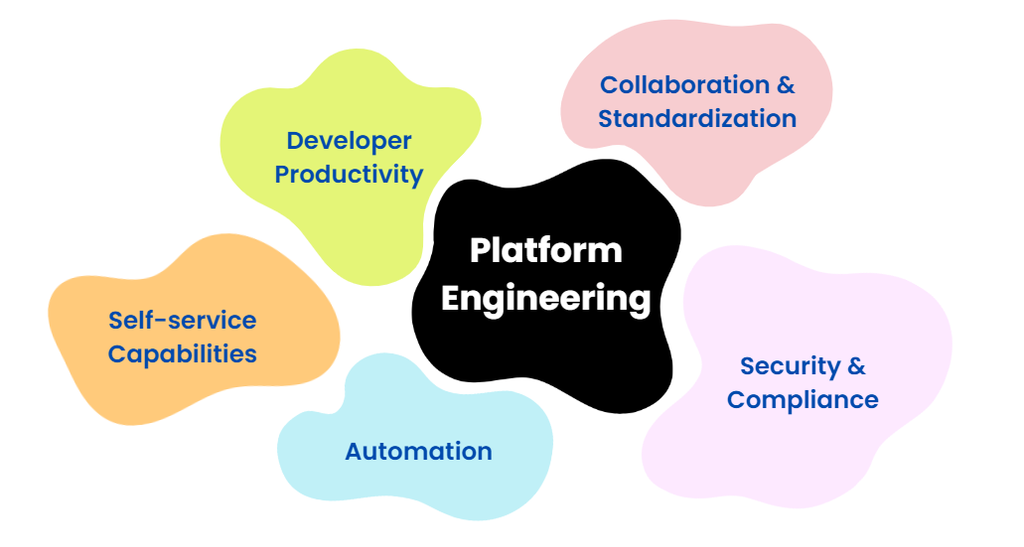
Build a platform developers choose to use
A developer portal alone does not remove engineering friction.
We start with the repeated tasks and delays that consume the most time, then build self-service around those problems. The platform grows as a product based on adoption, feedback and real developer needs — not around a catalogue of tools.
The best platform becomes the easiest way to do the right thing.
We provide:
Internal developer platform architecture
Golden Paths and self-service workflows
Reusable infrastructure and delivery services
Platform operating model and adoption roadmap

Benefits of Platform Engineering
Frequently Asked Questions
What is Platform Engineering?
Platform engineering is the practice of building and operating shared capabilities that make software development easier for product teams.
A platform can combine infrastructure provisioning, CI/CD, runtimes, security, observability, documentation and other engineering services behind reusable interfaces.
The main goal is to reduce unnecessary developer cognitive load and provide a safer, faster path to production. Google and CNCF both describe self-service and the platform-as-a-product model as core principles.
What is an Internal Developer Platform?
An internal developer platform is the set of tools, automation and workflows through which development teams consume shared engineering capabilities.
For example, a developer may use the platform to create a new service, provision an environment, deploy an application, request a database or access logs without knowing every detail of the infrastructure behind those actions.
The platform should abstract unnecessary complexity rather than hide everything.
Is an Internal Developer Portal the same as a platform?
No.
A developer portal can be a useful interface for service catalogues, documentation and workflows, but it is only one part of a platform.
Google explicitly notes that an internal developer platform may or may not include a developer portal. The important capabilities are the automation, services, governance and workflows behind that interface.
So installing Backstage or another portal does not automatically create a useful developer platform.
What are Golden Paths?
Golden Paths are supported and automated ways of completing common engineering tasks.
For example, a Golden Path for a new service might create the repository, pipeline, deployment configuration, infrastructure, monitoring and security defaults in one workflow.
They should make common cases easier without becoming rigid rules for every workload.
CNCF’s current maturity guidance makes the same point: start with common, repeatable pain and build a path that is genuinely better than the manual alternative.
Do we need Kubernetes for Platform Engineering?
No.
Kubernetes can be an important application platform, but platform engineering is broader than Kubernetes.
An internal platform can support Kubernetes, virtual machines, serverless services, managed databases, SaaS platforms or other runtimes.
We are infrastructure and cloud agnostic. The platform should create a useful developer experience across the technologies your applications actually require.
How is Platform Engineering different from DevOps?
DevOps provides principles and practices for development and operations teams to deliver and operate software together.
Platform engineering turns many of those practices into reusable internal capabilities.
For example, instead of each product team designing its own CI/CD pipeline, security checks and infrastructure automation, the platform team can provide a supported delivery path that teams consume through self-service.
Microsoft describes internal developer platforms as building on existing DevOps and DevSecOps systems rather than replacing them.
How do you decide what should become self-service?
We start with real developer friction.
We look for common tasks that are repetitive, slow or require another team only because of permissions or technical complexity. Environment creation, application onboarding, database provisioning, deployment and access requests are common examples.
Microsoft recommends focusing self-service first on tasks that are tedious or that developers cannot currently perform themselves without going through a manual service process.
We do not try to automate every possible exception from day one.
How do you measure whether a developer platform is successful?
We look at whether engineering work becomes easier, faster and more predictable.
Useful measures can include onboarding time, environment provisioning time, lead time to production, platform adoption, support requests, failed workflows and developer feedback.
But adoption alone is not enough. Teams should choose the platform because it gives them a better path than building the same capability themselves.
CNCF’s maturity model treats adoption, interfaces, operations and measurement as separate dimensions for exactly this reason.
Turn your Technology Challenge into a clear Delivery Plan
Nubes Consulting Digital helps design, modernize and operate complex technology environments. From Cloud and Architecture to DevOps, SRE and Engineering Delivery, we focus on practical decisions, reliable execution and measurable business outcomes.
