
Service
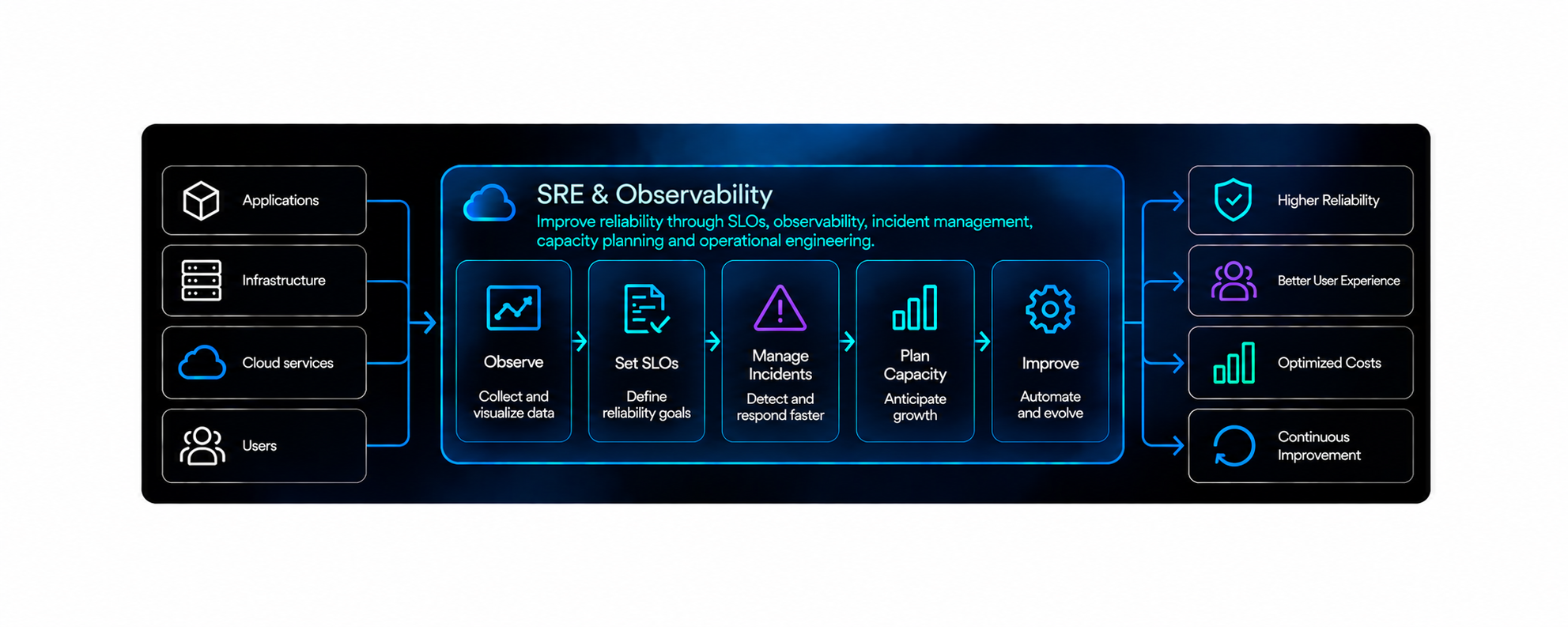
SRE & Observability
Improve reliability through SLOs, observability, incident management, capacity planning and operational engineering.

Make reliability measurable before incidents make it visible
Reliable systems need more than dashboards and alerts. Teams need to know what users depend on, how much failure is acceptable and what to do when service quality starts to degrade.
We help establish SRE and observability practices around SLOs, telemetry, incident management, capacity planning and operational engineering so reliability becomes something teams can measure and improve.
Typical scenarios:
Monitoring produces noise, not answers – teams receive many alerts but still struggle to understand user impact.
Incidents take too long to resolve – ownership, diagnostics or response processes are unclear.
Reliability competes with delivery speed – there is no shared way to decide when reliability work should take priority.
Growth creates operational risk – capacity, dependencies and failure modes are not understood well enough before demand increases.
How do SRE & Observability work?
We define service reliability from the user’s point of view, instrument the systems that deliver it, and use operational evidence to improve incidents, capacity and engineering priorities.
What do SRE & Observability include?
Site Reliability Engineering applies software engineering to production operations. Observability provides the telemetry needed to understand how systems behave. Together, they connect service health, user experience and engineering decisions.
From dashboards to reliability engineering
Observability is useful only when teams can act on it.
We connect telemetry with service ownership, SLOs, actionable alerts, incident response and engineering work. Instead of adding more dashboards, we focus on the signals that help teams understand customer impact and make faster decisions.
We provide:
SLI, SLO and error-budget design
Observability architecture and instrumentation
Incident and post-incident engineering
Capacity planning and toil reduction

Benefits of SRE & Observability
Frequently Asked Questions
What is Site Reliability Engineering?
Site Reliability Engineering, or SRE, applies software-engineering methods to operating production systems.
It combines reliability targets, observability, automation, incident response, capacity management and continuous improvement.
The goal is not perfect uptime at any cost. It is to achieve the level of reliability users and the business actually need while allowing engineering teams to keep delivering change.
Google Cloud describes SRE as both a mindset and a set of engineering practices for running reliable production systems.
What is the difference between monitoring and observability?
Monitoring normally tells you whether known conditions are happening.
Observability goes further. It gives engineers enough telemetry to investigate system behaviour and answer questions they did not know in advance.
That normally combines metrics, logs and distributed traces with useful context across applications and infrastructure.
OpenTelemetry describes observability in similar terms: understanding a system from its outputs and being able to investigate both known and previously unknown problems.
What are SLIs, SLOs and error budgets?
An SLI is a measurement of service behaviour, such as successful requests or latency.
An SLO defines the desired target for that measurement over a period of time.
An error budget represents the amount of unreliability that the service can tolerate while still meeting the SLO.
These measures create a common language between product, development and operations teams. Google emphasizes that they are most useful when they represent user experience and have agreed consequences when reliability falls outside the target.
Should every service have 99.99% availability?
No.
Higher reliability normally requires additional architecture, operating effort and cost.
We set SLOs based on user expectations, business impact, dependencies and what the architecture can realistically support.
A non-critical internal tool should not automatically receive the same reliability target as a payment or customer-facing platform.
Google’s SRE guidance specifically recommends setting targets around what users need rather than pursuing maximum reliability without considering the trade-off.
How do you improve incident response?
We first make sure important services have clear ownership, actionable alerts and enough telemetry to diagnose failures.
We then define severity, escalation, roles, communication, runbooks and post-incident review.
After an incident, the goal is not simply to close the ticket. We identify contributing factors and turn them into engineering actions that reduce the chance or impact of recurrence.
Google recommends preparing alerting and on-call processes before incidents happen, while Microsoft similarly emphasizes clear roles, end-to-end telemetry and documented incident response plans.
Can you work with our existing observability tools?
Yes.
We are tool and cloud agnostic.
We can work with platforms such as Prometheus, Grafana, OpenTelemetry, Elastic, Datadog, Dynatrace, Splunk and cloud-native monitoring services where they already fit your environment.
The first question is not which observability product to buy. It is which services matter, what signals are needed and whether the telemetry helps engineers make better operational decisions.
AWS also frames observability as a people, process and technology capability that should work regardless of the specific toolset.
How is SRE & Observability different from Managed Cloud Operations?
The services can work together, but they solve different problems.
Managed Cloud Operations focuses on ongoing operation of infrastructure: monitoring, maintenance, incidents, backups, patching and operational support.
SRE & Observability focuses on engineering reliability into services: SLOs, telemetry, incident learning, capacity, automation and reducing operational toil.
A managed operations team can run the environment, while SRE practices help make that environment and the applications on it easier and safer to operate over time.
Can SRE work across distributed or hybrid environments?
Yes.
SRE principles do not depend on one cloud provider or runtime.
The same reliability approach can cover applications running across public cloud, private infrastructure, Kubernetes, virtual machines and hybrid environments.
A consistent telemetry layer can also reduce operational fragmentation. OpenTelemetry, for example, is specifically designed as a vendor-neutral framework for generating and exporting metrics, logs and traces.
This area is also supported by your existing delivery experience: the published Amway engagement involved leading an L2/L3 SRE team across the USA, Brazil, EU and India and designing incident escalation, shift handover and knowledge-sharing processes across more than 12 hours of time-zone difference.
Turn your Technology Challenge into a clear Delivery Plan
Nubes Consulting Digital helps design, modernize and operate complex technology environments. From Cloud and Architecture to DevOps, SRE and Engineering Delivery, we focus on practical decisions, reliable execution and measurable business outcomes.
