
Service
Cloud & Infrastructure Architecture
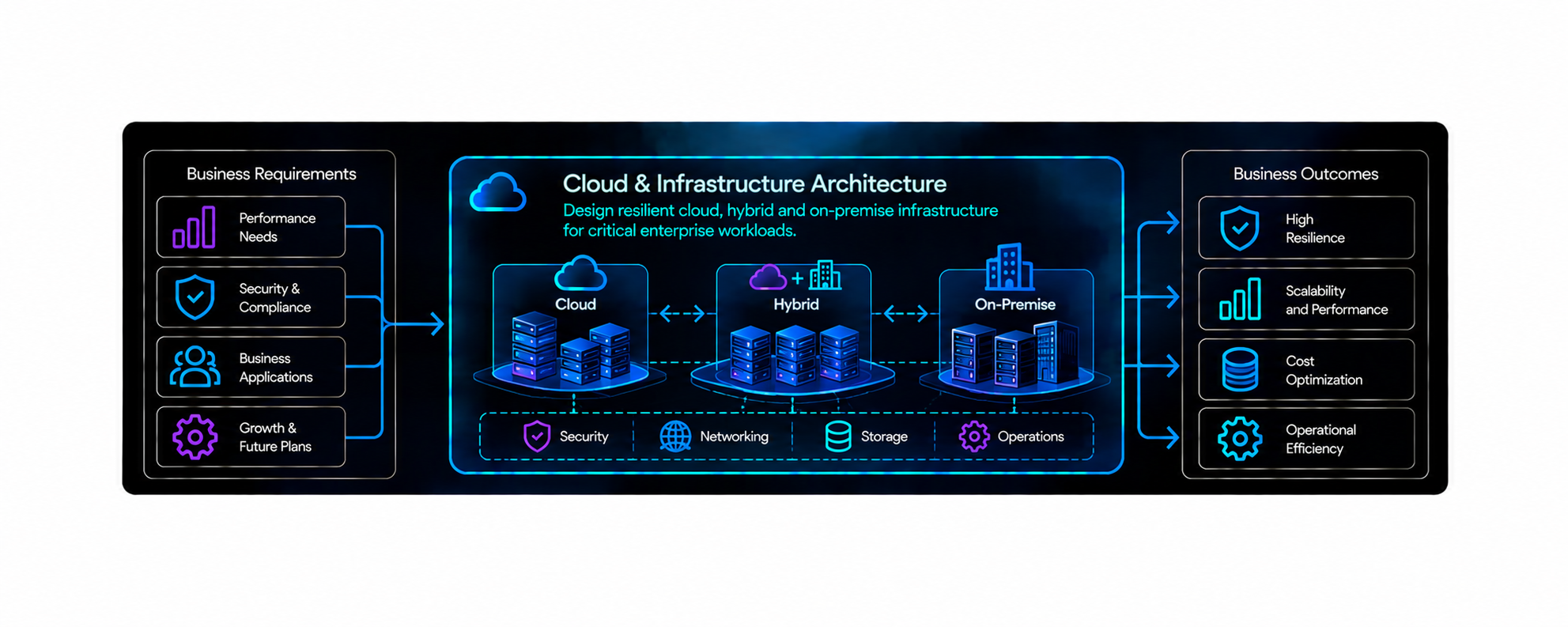
Design resilient cloud, hybrid and on-premise infrastructure for critical enterprise workloads.

Design infrastructure around the workload, not the platform
Critical enterprise systems rarely depend on one technology or one location. Applications, data, networks and operational dependencies often span cloud services, private infrastructure and existing data centers.
We design resilient cloud, hybrid and on-premises architectures around real workload requirements, including availability, performance, security, recovery, cost and long-term operational control.
Typical scenarios:
A critical workload needs a new target architecture – but cloud, private infrastructure and hybrid options all have different trade-offs.
Cloud and data-center environments have grown separately – networking, identity and operational models no longer fit together cleanly.
Resilience requirements have increased – the current architecture cannot prove how it behaves during infrastructure, network or regional failure.
A major infrastructure decision is approaching – data-center exit, hardware renewal, cloud expansion or platform change requires a longer-term architecture.
How does Cloud & Infrastructure Architecture work?
We start with workload requirements and dependencies, define the required resilience and operating model, then design the infrastructure, connectivity and placement needed to support them.
What does Cloud & Infrastructure Architecture include?
Infrastructure architecture connects workload needs with real technology decisions. It defines where systems run, how environments communicate, what happens when components fail and how the whole estate can be secured and operated.

Design for the failure you cannot avoid
Resilient architecture is not created by adding more infrastructure everywhere.
We identify which failures matter, which dependencies can become single points of failure and how much redundancy the workload actually requires.
The architecture should continue operating where possible, recover predictably where it cannot, and be simple enough for the organization to operate during a real incident.
We provide:
Cloud, hybrid and on-premises target architecture
Workload placement and infrastructure patterns
Network, resilience and disaster recovery design
Architecture decisions and implementation roadmap

Benefits of Cloud & Infrastructure Architecture
Frequently Asked Questions
How do you decide whether a workload should run in cloud or on-premises?
We start with workload requirements rather than a preferred destination.
We look at factors such as:
- availability and recovery requirements,
- latency and network dependencies,
- data location and security,
- application architecture,
- performance and capacity,
- platform dependencies,
- operating skills,
- cost and commercial commitments,
- portability and future change.
Some workloads benefit strongly from managed cloud services. Others may fit private infrastructure better. Many enterprise systems need a hybrid architecture during transition or for the longer term.
The target should follow the workload.
What is hybrid cloud architecture?
Hybrid architecture connects workloads and services running in different environments, typically public cloud with private cloud, colocation or on-premises infrastructure.
The difficult part is rarely drawing two environments on the same diagram.
Identity, routing, DNS, security, latency, monitoring and failure handling need to work across the boundary.
AWS specifically warns that hybrid-network reliability depends on both environments and the connections between them, because a failure in one network path can affect the availability of the complete workload.
Does hybrid cloud automatically improve resilience?
No.
Adding another environment can actually add more failure modes if workloads depend on synchronous services across unreliable or slow network links.
Hybrid resilience needs deliberate design.
For example, Microsoft recommends redundant connectivity paths, different peering locations and, for critical workloads, geographically diverse connectivity rather than relying on a single private circuit.
We look at the complete service path rather than assuming two locations automatically mean high availability.
How do you design infrastructure for critical workloads?
We first identify the business flows that must remain available and what failure the business can tolerate.
From there we define availability and recovery targets and examine failure domains across compute, storage, data, networking and dependent services.
The architecture may then use multiple instances, zones, sites or regions where those measures are justified.
Google’s reliability guidance follows the same principle: distribute critical workload components across independent failure domains when the required availability justifies it.
Do critical workloads always need multi-region architecture?
No.
Multi-region architectures can improve resilience against regional failures, but they also add cost, data replication, operational complexity and additional failure modes.
The architecture should reflect the business impact of an outage.
For some systems, zone-level redundancy and tested regional recovery are enough. For others, regional failure cannot be tolerated and a multi-region model is justified.
Microsoft’s current Well-Architected guidance explicitly treats reliability as a trade-off with cost, security and operational complexity rather than something that should simply be maximized.
How do you design hybrid network connectivity?
We look at bandwidth, latency, routing, availability, security and the importance of the workloads using the connection.
Depending on the environment, this can include provider-native private connectivity, carrier services, VPN, SD-WAN or combinations of several paths.
The important part is avoiding a hidden network single point of failure.
Microsoft, for example, recommends redundant ExpressRoute circuits from different peering locations for higher resilience and allows VPN to provide an additional path in suitable scenarios.
The same architectural principle applies regardless of cloud provider: the backup path has to support the workload when the primary path is gone.
Can you design architecture across multiple cloud providers?
Yes.
We are cloud agnostic and can design architectures involving public, regional or sovereign cloud providers together with private and on-premises infrastructure.
But we do not recommend multi-cloud simply to say that an organization uses several providers.
A multi-cloud design should solve a concrete requirement such as workload placement, regulatory constraints, acquisition history, geographic needs, service capability or concentration risk.
Otherwise it can increase networking, identity, skills and operational complexity without creating equivalent value.
What do we receive from an architecture engagement?
The exact deliverables depend on scope, but typically include:
- target infrastructure architecture,
- workload placement decisions,
- network and connectivity architecture,
- availability and failure-domain model,
- backup and disaster recovery approach,
- security and management architecture,
- architecture decision records,
- risks and assumptions,
- implementation roadmap.
For critical systems, we can also define implementation checkpoints and continue through Architecture Review & Assurance.
Turn your Technology Challenge into a clear Delivery Plan
Nubes Consulting Digital helps design, modernize and operate complex technology environments. From Cloud and Architecture to DevOps, SRE and Engineering Delivery, we focus on practical decisions, reliable execution and measurable business outcomes.
