
Service
Cloud Migration Assessment & Planning
Discover workloads and dependencies, assess readiness and build the business case, target model and migration roadmap.


Know what you are moving before the migration starts
Cloud migrations become expensive when workloads, dependencies, ownership and target architecture are discovered during execution.
We assess your current estate, identify what should move, define realistic migration strategies and build the business case, target model and migration roadmap before major delivery commitments are made.
Typical scenarios:
Data center or contract deadline – migration needs a realistic scope, sequence and timeline.
Cloud strategy is approved but the plan is unclear – teams know where they want to go, but not how to get there.
The estate is poorly documented – dependencies, owners and critical systems are not fully understood.
A migration business case needs validation – cost, effort, risk and target assumptions need stronger evidence.
How does Cloud Migration Assessment & Planning work?
We combine automated discovery, architecture analysis and stakeholder knowledge to turn an uncertain technology estate into clear workload decisions, migration waves and an executable roadmap.
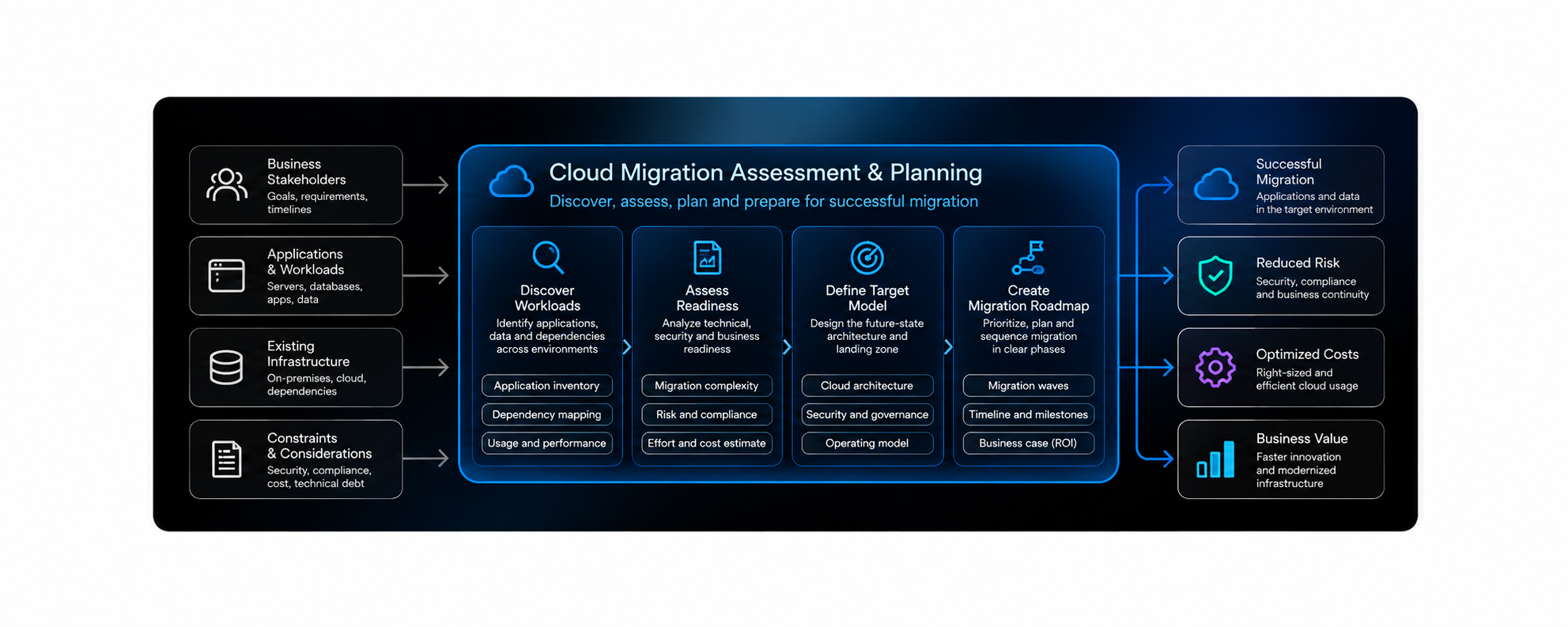
What does a cloud migration assessment cover?
A migration assessment creates an evidence-based view of your applications, infrastructure and business requirements. It identifies dependencies, readiness, migration options and target requirements so decisions can be made before cost and risk move into the execution phase.

From an infrastructure inventory to an executable migration plan
A list of servers is not a migration plan.
We connect technical discovery with application ownership, business criticality, resilience, security, operating constraints and economics. Assumptions are recorded and validated so migration teams know what must move together, what can move independently and what should not move yet.
We provide:
Application and infrastructure discovery
Dependency and migration-strategy assessment
Target architecture and business case
Migration waves, roadmap and readiness plan

Benefits of Cloud Migration Assessment & Planning
Planning a migration but still missing a reliable view of the estate?

Frequently Asked Questions
What is a cloud migration assessment?
A cloud migration assessment evaluates the applications, infrastructure, data, dependencies and business requirements involved in a potential migration.
It helps determine what should move, which migration approach fits each workload, what the target environment needs and how the migration should be sequenced.
The outcome should be a decision and plan – not simply a technical inventory.
What information do you need to start?
We work with the information you already have and identify where evidence is missing.
Typical inputs include infrastructure inventories, CMDB data, architecture diagrams, monitoring data, cloud bills, application lists, network information and interviews with technical and business owners.
Where useful, discovery tools can collect more accurate infrastructure and dependency data.
AWS recommends exactly this progressive approach: start from available data, identify gaps and improve data quality rather than waiting for a perfect inventory before beginning.
How do you discover application dependencies?
We combine several sources rather than relying on one document.
Depending on the estate, this can include automated discovery, network communication data, configuration, monitoring, application information and interviews with system owners.
The goal is to understand which components must move together and which dependencies can temporarily operate across environments.
Both AWS and Microsoft treat dependency data as a key input for migration waves because breaking dependencies during migration can create service disruption.
Do you assume every workload should move to cloud?
No.
We are cloud agnostic and the assessment should be able to recommend that a workload is migrated, modernized, retained, replaced or retired.
For workloads that should move, we also assess the appropriate destination and migration pattern rather than assuming one provider or one technical approach from the beginning.
This is important because even provider frameworks include retain and retire alongside migration strategies. AWS, for example, uses seven migration strategies including retain, retire, rehost, relocate, repurchase, replatform and refactor.
What is included in the migration business case?
The exact model depends on the program, but it normally includes current infrastructure and operating costs, target platform costs, migration effort, licensing, connectivity, transition costs and expected changes to operations.
We also include assumptions that can materially change the result, such as dual-running environments, migration duration, skills and decommissioning timelines.
The goal is to show the economics of the transition—not just compare the monthly price of current servers with target cloud resources.
How do you create migration waves?
We group workloads using application dependencies, business criticality, technical complexity, timing constraints and delivery capacity.
Lower-risk workloads can often be used to validate the migration process before more critical systems move.
The roadmap remains iterative. Later waves should become more detailed as new information and lessons from earlier migrations become available.
Microsoft and Google both recommend dependency-based waves and progressive planning rather than defining every later migration in full detail before execution begins. Microsoft Learn
Does the assessment include the target cloud architecture?
Yes, at the level required to make migration decisions and plan the program.
We define target hosting patterns, platform requirements, network and identity dependencies, security constraints, resilience expectations and the landing-zone capabilities required before workloads arrive.
Detailed workload implementation designs can then be completed as each migration wave approaches.
This avoids two common extremes: starting migration without a target model, or trying to design every application in full before the migration program has learned anything.
What do we receive at the end of the assessment?
The exact deliverables depend on scope, but a typical engagement produces a validated application and infrastructure inventory, dependency view, workload migration strategies, target architecture principles, readiness gaps, business case and prioritized migration roadmap.
The plan should be usable by architecture, migration teams, program leadership and business stakeholders – not only by the people who performed the assessment.
Turn your Technology Challenge into a clear Delivery Plan
Nubes Consulting Digital helps design, modernize and operate complex technology environments. From Cloud and Architecture to DevOps, SRE and Engineering Delivery, we focus on practical decisions, reliable execution and measurable business outcomes.