
Service
Cloud Governance & CCoE
Establish cloud standards, ownership, policies and a Cloud Center of Excellence for enterprise-scale adoption.


Scale Cloud without losing control
As cloud adoption grows, teams, accounts, costs and architecture decisions can quickly become fragmented.
We establish practical cloud governance and Cloud Centers of Excellence that define ownership, standards and decision rights while giving engineering teams a clear path to build and operate in the cloud.
Typical scenarios:
Cloud adoption is scaling – more teams need clear standards and ownership.
Governance is inconsistent – different environments follow different architecture, security and delivery rules.
Multi-cloud is growing – common principles are needed across providers without forcing them into one model.
Your existing CCoE is not working – governance exists on paper but teams still work around it.
How do Cloud Governance & CCoE work?
We connect cloud strategy, architecture, security, operations, cost and engineering through clear ownership, reusable standards and automated guardrails.
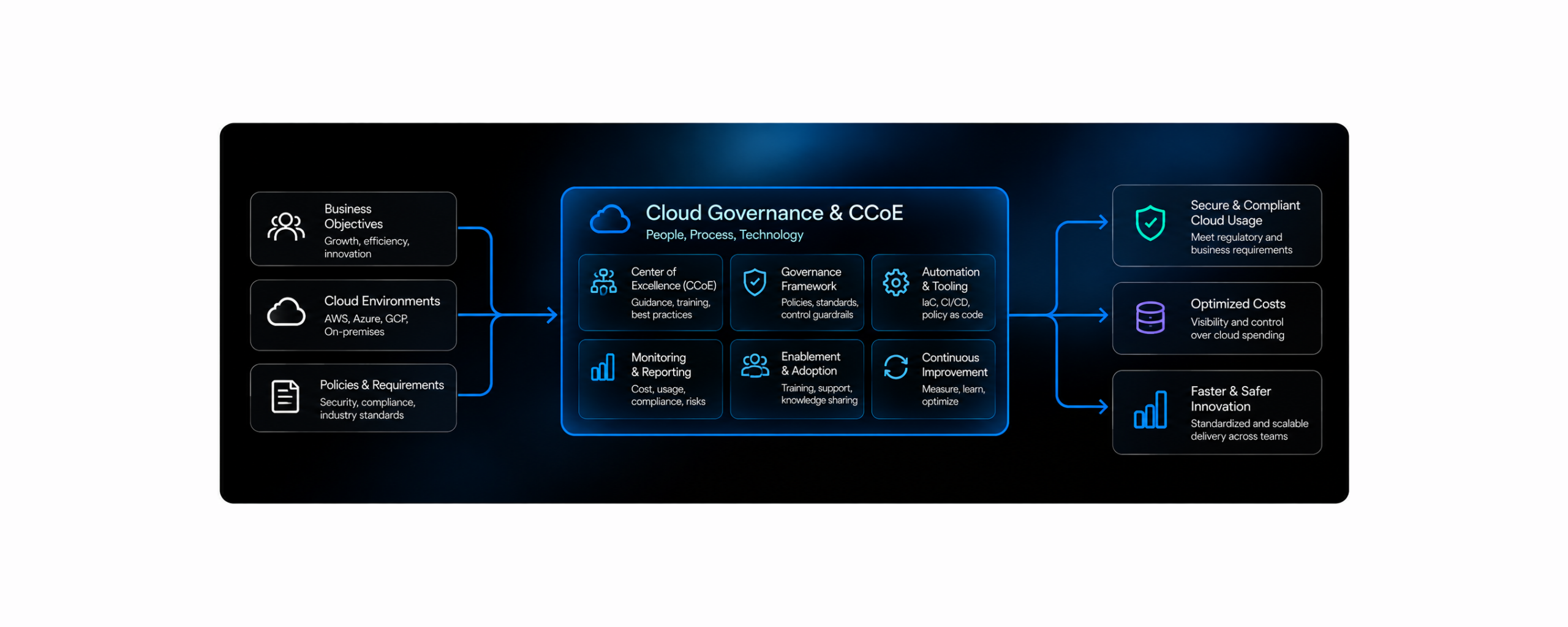
What is a Cloud Center of Excellence?
A Cloud Center of Excellence is a cross-functional function that defines how cloud is adopted and operated across the organization. It brings together architecture, platform, security, operations, finance and engineering so cloud decisions are made consistently instead of team by team.

From Cloud rules to an Operating Model
Cloud governance should not become a collection of documents that nobody follows.
We translate principles into ownership, architecture patterns, service standards, Infrastructure as Code and controls that fit the way your teams actually deliver technology.
The goal is simple: make the approved path easier than the exception.
We provide:
CCoE structure and operating model
Cloud policies and architecture standards
Roles, RACI and decision processes
Governance automation and adoption roadmap

Benefits of Cloud Governance & CCoE
Frequently Asked Questions
What is a Cloud Center of Excellence?
A Cloud Center of Excellence, or CCoE, is a cross-functional function that guides cloud adoption across an organization.
It typically brings together architecture, platform engineering, security, operations, finance and delivery to define standards, ownership and reusable ways of working.
The exact structure should reflect your organization rather than follow a fixed template.
What is the difference between cloud governance and a CCoE?
Cloud governance defines the rules, responsibilities and controls used to manage cloud.
A CCoE is one possible organizational model for creating, maintaining and improving that governance while helping teams adopt cloud successfully.
You can have cloud governance without a formal CCoE, and smaller organizations may not need a permanent standalone team.
Does a CCoE slow engineering teams down?
It should not.
A poorly designed CCoE can become another approval committee. A good one reduces repeated decisions by providing approved architectures, reusable infrastructure, clear policies and automated guardrails.
The long-term goal is controlled self-service rather than manual approval for every cloud change.
Who should be part of a CCoE?
The exact structure depends on the organization, but the function normally needs representation from cloud architecture, platform engineering, security, operations, finance or FinOps, and application delivery.
Executive sponsorship is also important because governance decisions often cross existing organizational boundaries.
AWS specifically recommends an empowered leader and cross-functional collaboration rather than an isolated technical team.
Can you establish a CCoE for multi-cloud environments?
Yes.
We are cloud agnostic and can design governance across AWS, Azure, Google Cloud, Oracle Cloud Infrastructure, private platforms and other providers.
We standardize areas such as ownership, tagging, Infrastructure as Code, security expectations and cost visibility while keeping provider-specific architecture explicit where required.
AWS also recommends a centralized cloud leadership function when organizations deliberately adopt multi-cloud. AWS Documentation
What should cloud governance cover?
The exact scope depends on your estate, but it commonly includes ownership, account or subscription structures, architecture standards, identity, security, networking, Infrastructure as Code, service approval, tagging, cost management, operational requirements and exception handling.
Governance should also define how standards are reviewed and changed as cloud services and business needs evolve.
Can you improve an existing CCoE?
Yes.
Many CCoEs exist formally but struggle because their mandate is unclear, standards are not enforced, teams see them as blockers, or the function is disconnected from platform engineering and delivery.
We can review the current model, responsibilities, governance processes and technical controls, then simplify and strengthen what already exists rather than rebuilding it automatically.
How do you measure whether a CCoE is working?
The metrics should reflect the problems the CCoE was created to solve.
Typical measures can include environment provisioning time, adoption of approved patterns, policy exceptions, cloud spend allocation, security findings, migration throughput and engineering satisfaction.
AWS specifically recommends defining CCoE KPIs and using them to demonstrate value to leadership rather than measuring success by the number of policies or meetings created.
Turn your Technology Challenge into a clear Delivery Plan
Nubes Consulting Digital helps design, modernize and operate complex technology environments. From Cloud and Architecture to DevOps, SRE and Engineering Delivery, we focus on practical decisions, reliable execution and measurable business outcomes.
