
Service
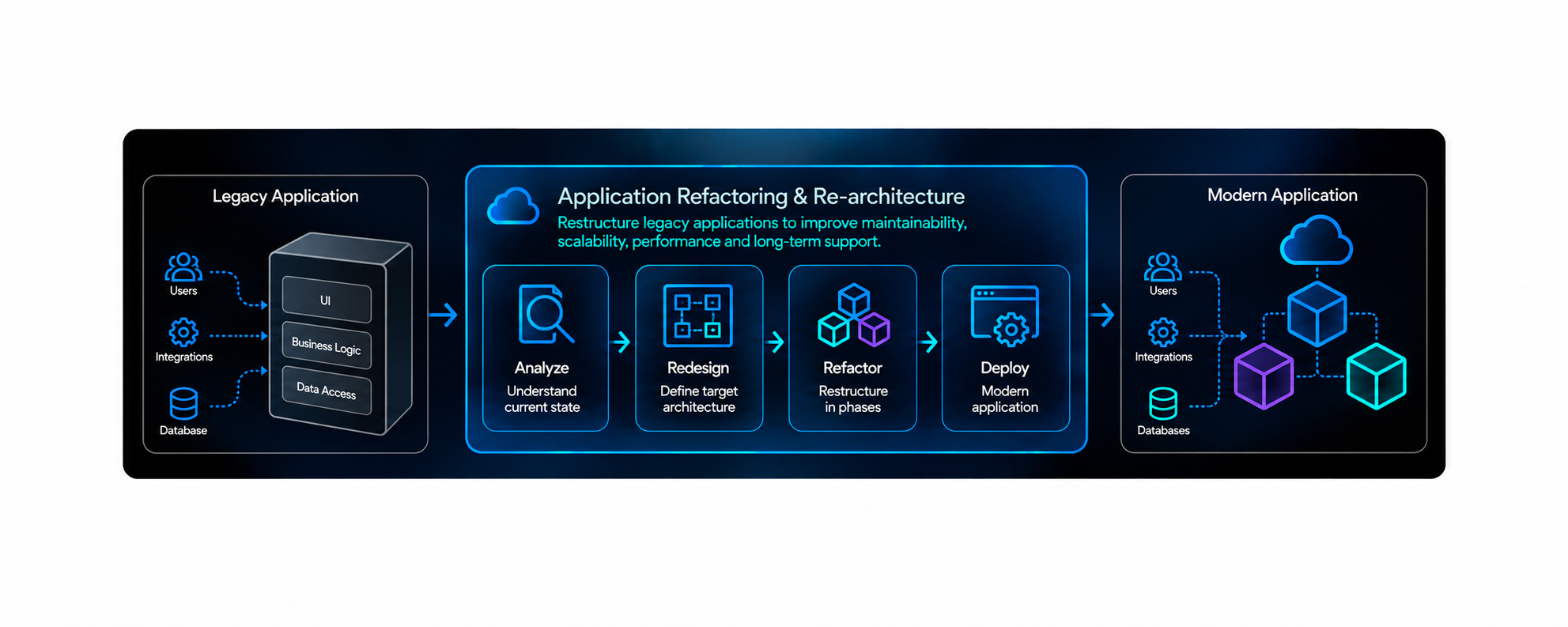
Application Refactoring & Re-architecture
Restructure legacy applications to improve maintainability, scalability, performance and long-term support.


Improve the application without starting again
Legacy applications often still provide important business value, but years of changes can make them difficult to maintain, test, scale and release.
We refactor code and reshape application architecture to reduce technical debt, improve performance and reliability, and make future change easier without forcing a complete rewrite.
Typical scenarios:
Changes take too long – even small features require risky changes across a large codebase.
Technical debt dominates delivery – teams spend more time working around old design decisions than building new value.
Performance or scalability has reached a limit – the application architecture no longer fits current workload demand.
The technology stack is becoming difficult to support – frameworks, runtimes or dependencies need a controlled path forward.
How do Application Refactoring & Re-architecture work?
We identify the code and architecture that create the most friction, define the target structure and improve the system in controlled steps while keeping business behaviour stable.
What does application refactoring include?
Refactoring improves the internal design of an existing application. Re-architecture goes further when component boundaries, state management, deployment or communication patterns need to change. The right approach depends on what is actually limiting the system.

Change the parts that create the constraint
A legacy application does not need to become microservices to become easier to maintain.
Sometimes the best target is a cleaner modular application with updated frameworks, stronger tests and better deployment. In other cases, selected components need deeper architectural change.
We choose the smallest transformation that solves the real problem and leaves a clear path for future modernization.
We provide:
Code and architecture assessment
Refactoring and framework modernization
Modularization and architecture redesign
Testing, performance and delivery improvements

Benefits of Application Refactoring & Re-architecture
Frequently Asked Questions
What is application refactoring?
Application refactoring changes the internal structure of software without intentionally changing what the application does for its users.
Examples include simplifying complex code, removing duplication, separating responsibilities, upgrading frameworks or improving dependency management.
The goal is to make the system easier to understand, test and change.
Microsoft describes refactoring similarly: restructure code to improve performance, scalability or maintainability while keeping external behaviour stable.
What is the difference between refactoring and re-architecture?
Refactoring usually works inside the existing application structure.
Re-architecture changes larger design decisions such as component boundaries, communication, state management, data flow or deployment architecture.
For example, cleaning up a complex service is refactoring. Dividing a tightly coupled application into clear modules with asynchronous communication may require re-architecture.
We use the smallest level of change that solves the problem.
Do we need to rewrite the application?
Usually not.
A rewrite discards the existing implementation and recreates the system, which also means rediscovering years of hidden behaviour and edge cases.
Where the existing application still provides valuable business capability, controlled refactoring can preserve that knowledge while improving the areas that create the most cost or risk.
Microsoft’s modernization guidance explicitly treats refactor, rearchitect and rebuild as different strategies because rebuilding is not automatically the best path.
Does refactoring mean moving to microservices?
No.
A modular monolith can often provide much better maintainability without introducing the network, deployment and operational complexity of microservices.
We recommend microservice decomposition only where independent deployment, scaling or ownership creates real value.
If that need exists, the work can continue under our Monolith to Microservices service.
Can you modernize the technology stack at the same time?
Yes.
Refactoring can include runtime and framework upgrades, replacing unsupported libraries, removing platform-specific dependencies or making the application suitable for containers or managed platforms.
But we avoid combining too many unrelated changes into one step.
The architecture, test coverage and operational risk determine how much can safely change together.
AWS similarly recommends assessing dependencies, interfaces, framework versions, test coverage and application characteristics before committing to a refactoring path.
How do you refactor a poorly tested legacy application?
We first create enough safety around the areas that will change.
This can include characterization tests, integration tests, runtime monitoring and additional observability to capture existing behaviour.
We then introduce smaller architectural seams where code can change without affecting unrelated parts of the system.
Martin Fowler describes these seams as points where behaviour can be redirected or isolated, making legacy systems easier to test and modernize incrementally.
Can refactoring improve performance and scalability?
Yes, when the architecture is the cause of the problem.
We first measure where time, resources or contention are actually spent. Improvements can then include caching, asynchronous processing, stateless execution, concurrency changes, better data access or redesign of specific application flows.
We avoid changing architecture based only on assumptions.
Microsoft specifically includes code scalability, performance optimization, caching and data changes within current refactor and re-architecture guidance.
How do you modernize without stopping normal product development?
We prefer incremental modernization around real delivery priorities.
Instead of freezing the application for a long transformation project, we identify high-value areas, establish target architecture rules and improve the system in manageable slices.
New functionality can often follow the new architecture while older parts are modernized when they are touched or when their risk justifies dedicated work.
AWS’s wave-based refactoring guidance similarly recommends discovery, analysis and phased implementation rather than treating modernization as one large event.
This approach also matches your published healthcare CRM work: the existing product remained business-critical, so the work focused on understanding current constraints, defining a modular target architecture and validating the direction through a representative proof of concept rather than starting with a complete rewrite.
Turn your Technology Challenge into a clear Delivery Plan
Nubes Consulting Digital helps design, modernize and operate complex technology environments. From Cloud and Architecture to DevOps, SRE and Engineering Delivery, we focus on practical decisions, reliable execution and measurable business outcomes.
