
Service
CTO Advisory & Technical Leadership
Provide senior architecture and technology leadership when the organization needs decision ownership rather than another report.

Bring Senior Technical ownership to decisions that cannot wait
Organizations often know that something must change, but the difficult part is deciding what to do, what not to do and who will own the technical consequences.
We provide senior CTO-level and architecture leadership to help executives make technology decisions, align teams and move complex initiatives from discussion into controlled execution.
Typical scenarios:
A major technology decision has no clear owner – cloud, modernization, platform or architecture choices keep moving between teams.
The organization needs senior leadership during change – a CTO, chief architect or transformation leader is missing, overloaded or temporarily unavailable.
Strategy and delivery are moving in different directions – engineering activity is high, but priorities and architecture are not aligned with business goals.
A critical program needs stronger technical control – migration, modernization, recovery or platform work involves several teams, vendors and difficult trade-offs.
How does CTO Advisory & Technical Leadership work?
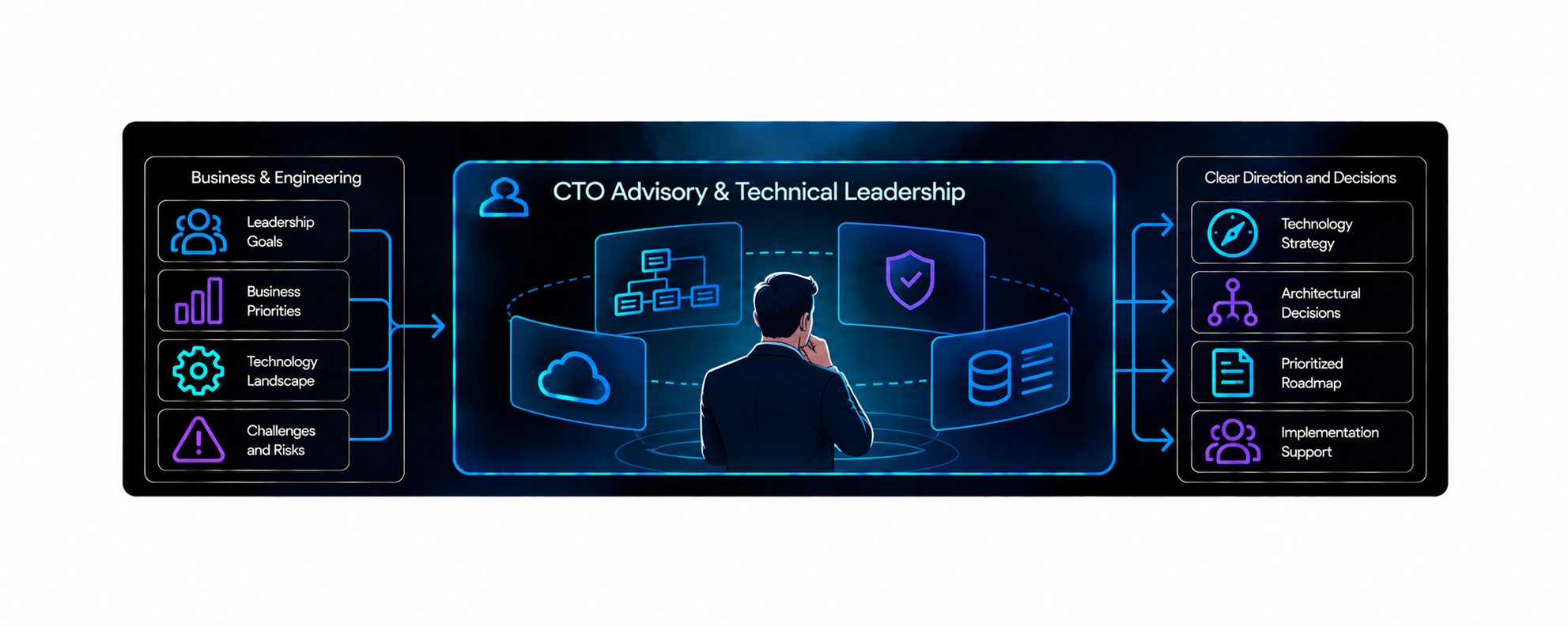
We work with executives and engineering leaders to frame the decision, evaluate the trade-offs, establish ownership and stay involved as architecture and strategy move into delivery.
What does CTO Advisory & Technical Leadership include?
The exact role depends on the situation. Sometimes the organization needs strategic advice. In other cases, it needs an interim technical leader who can make decisions, align teams and remain accountable through execution.
From technical advice to an executable decision
A useful technical decision has to survive contact with budgets, delivery teams, security, operations and existing systems.
We do not separate architecture from those constraints. We make the trade-offs visible, record important decisions and work with the people who must implement them.
The objective is not more governance. It is clearer decisions with less repeated debate.
We provide:
Technology strategy and architecture direction
Executive decision support and technical options
Architecture governance and decision records
Transformation leadership and delivery assurance

Benefits of CTO Advisory & Technical Leadership
Need someone to own the technical decision, not just advise on it?

Frequently Asked Questions
What is CTO advisory?
CTO advisory provides senior technology leadership without requiring the organization to build every capability internally before an important decision can be made.
The work can include technology strategy, architecture, investment priorities, operating models, vendor choices, transformation planning and delivery oversight.
The important part is that technical direction remains connected to business goals.
McKinsey’s 2026 technology research reflects this wider role: technology leaders are increasingly involved in company strategy and operating-model design rather than only managing IT delivery.
Is this the same as a fractional CTO?
It can be, but it does not have to be.
A fractional CTO usually provides ongoing senior technology leadership for part of the week or month.
Our involvement can also be shorter and focused on a specific decision, transformation or period of change.
Depending on the need, we can operate as an advisor, interim CTO, senior architect or technical program leader.
When does an organization need external technical leadership?
Common triggers include a leadership gap, major modernization, cloud or data-center change, rapid company growth, architecture disagreement, delivery recovery or an important vendor decision.
External leadership can also help when internal executives need an independent technical view before committing significant budget or accepting an irreversible architecture choice.
The value is highest when the problem crosses several teams and nobody currently owns the complete decision.
How is this different from hiring an enterprise architect?
An enterprise architect normally focuses primarily on architecture across systems, standards and technology domains.
CTO-level leadership has a wider decision scope.
It can include architecture, but also investment priorities, delivery structure, organization, partners, technical risk and how technology supports business strategy.
In practice, the roles may overlap. The right engagement depends on whether the main problem is architecture design or broader technology leadership.
Do you replace the client’s CTO or engineering leadership?
No, unless the engagement is explicitly an interim leadership role.
In most cases we strengthen the existing leadership team.
We can provide an independent second view, own a specific transformation area or take responsibility for decisions that require additional senior capacity.
The goal is to make internal leadership more effective, not create another permanent dependency.
How do you avoid architecture governance becoming bureaucracy?
We keep governance focused on decisions that have meaningful consequences.
Not every technical choice needs executive review.
Teams should make local decisions within clear boundaries, while decisions with major impact on security, cost, resilience, shared architecture or long-term lock-in receive wider review.
AWS recommends distributed ownership of architecture decisions and short decision records rather than forcing all architecture work through one central architect.
Can you help with vendor and technology selection?
Yes.
We can define requirements, compare technical and operational trade-offs, evaluate architecture fit and challenge vendor assumptions.
Where possible, we separate the decision from resale incentives.
The objective is not to choose the technology with the strongest sales presentation. It is to choose an option that fits the workload, operating model, risk and long-term strategy.
Can you stay involved after the strategy is approved?
Yes.
For complex programs, this is often where senior technical leadership creates the most value.
We can continue through architecture governance, technical reviews, vendor coordination, delivery checkpoints, risk escalation and major cutover decisions.
Your own published experience provides strong proof of this model. In the large three-data-center migration, you worked both as a delivery lead and as part of the central architecture team, making enterprise-level decisions while remaining connected to migration execution and C-level reporting.
Turn your Technology Challenge into a clear Delivery Plan
Nubes Consulting Digital helps design, modernize and operate complex technology environments. From Cloud and Architecture to DevOps, SRE and Engineering Delivery, we focus on practical decisions, reliable execution and measurable business outcomes.