
Service
Mainframe & COBOL Modernization
Assess and modernize mainframe applications, business logic, integrations and operating models.

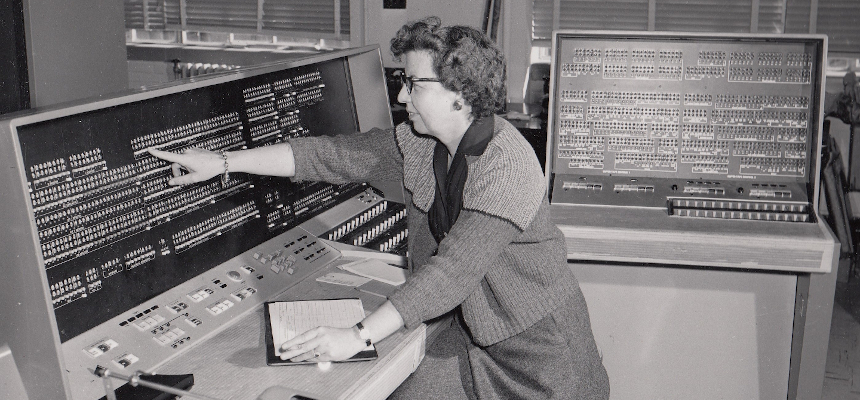
Modernize critical mainframe systems without losing the business inside them
Mainframe applications often contain decades of business rules, batch processes, integrations and operational knowledge that cannot be replaced safely by translating code alone.
We assess and modernize COBOL and mainframe systems in controlled stages, preserving critical behaviour while improving architecture, integration, development and long-term operations.
Typical scenarios:
COBOL skills are becoming scarce – important systems depend on knowledge held by a shrinking number of specialists.
Mainframe cost or licensing is under pressure – the organization needs credible alternatives before another long-term commitment.
Business change is too slow – tightly coupled applications and batch processes make even small changes difficult.
A modernization mandate already exists – but the organization still needs to understand what should stay, change or move first.
How does Mainframe & COBOL Modernization work?
We first understand applications, data, batch flows and business rules, then modernize bounded domains with clear target architecture, equivalence testing and staged coexistence.
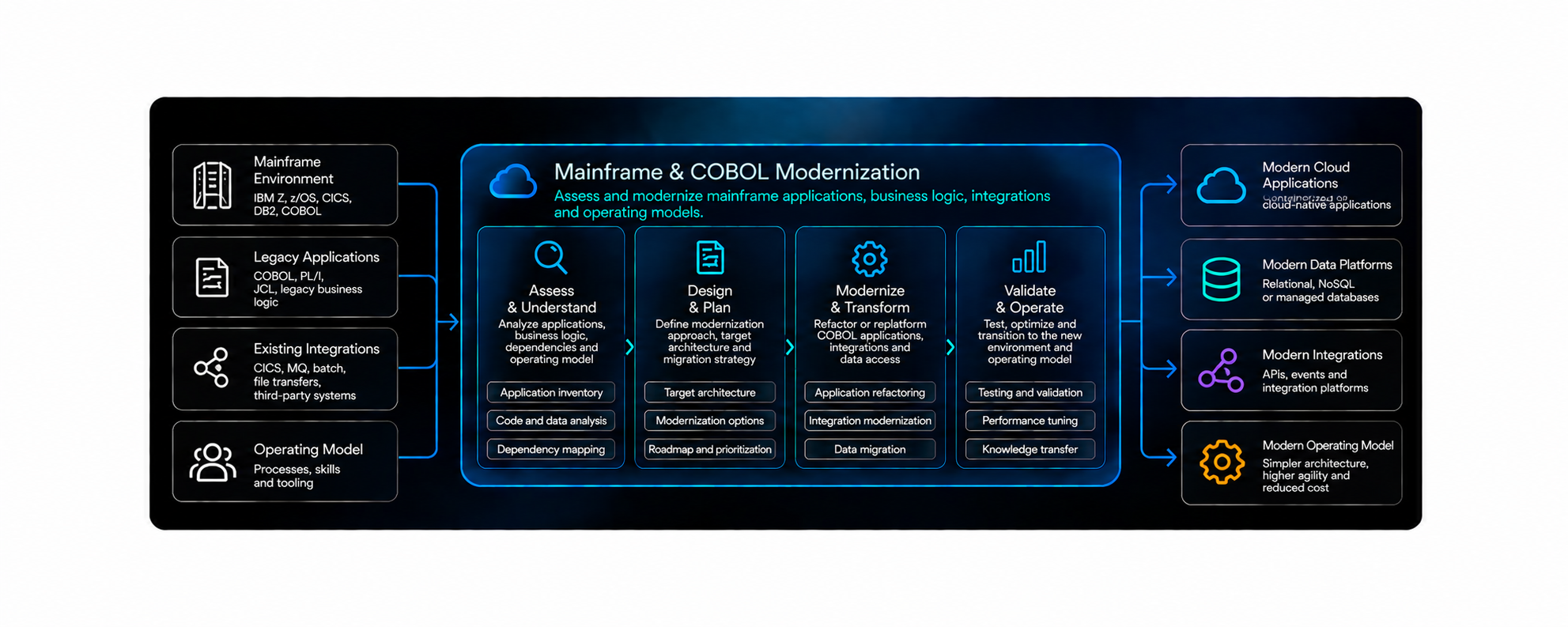
What does mainframe modernization include?
A mainframe application is more than COBOL source code. It can include JCL, CICS transactions, batch schedules, Db2 or VSAM data, interfaces, screens and operational procedures. Modernization must understand how these parts work together before changing them.
Modernize in domains, not through one big-bang rewrite
The whole mainframe does not need to move at once.
We identify business domains that can be understood, tested and modernized independently. Some can stay on the mainframe with better APIs. Others can be refactored, replatformed or replaced.
The goal is to reduce risk while creating a realistic path away from the parts that are limiting the business.
We provide:
Mainframe application and dependency assessment
Business-rule and domain discovery
Modernization architecture and proof of value
Equivalence, coexistence and cutover strategy

Benefits of Mainframe & COBOL Modernization
Need a modernization path without betting the business on a rewrite?

Frequently Asked Questions
What is mainframe modernization?
Mainframe modernization improves how critical mainframe applications are understood, changed, integrated and operated.
It can include better documentation and APIs, code refactoring, language transformation, data modernization, replatforming or replacing selected business domains.
It does not always mean leaving the mainframe.
The right path depends on business value, cost, risk, architecture and how strongly each workload depends on the current platform.
Do we need to convert all COBOL to Java?
No.
Automatic conversion can be useful for selected workloads, but language conversion is only one modernization option.
A stable application may remain in COBOL while its interfaces and delivery model are improved. Another domain may be extracted into services. A third may be replaced by a product.
IBM itself supports incremental refactoring into business services as well as COBOL-to-Java transformation, which shows that conversion is not the only available path.
Can AI automatically modernize our mainframe?
AI can now help significantly with code explanation, documentation, business-function discovery, test generation and candidate code transformation.
AWS Transform, IBM watsonx Code Assistant for Z and Google’s mainframe tooling all provide capabilities in these areas.
But this does not remove the need for architecture, domain knowledge, testing and human approval.
The Nubes research is explicit on this point: mainframe conversion is a program, not a prompt. AI can help understand and generate candidates, but production modernization still needs controlled validation and equivalence evidence.
How do you understand undocumented COBOL applications?
We combine several forms of evidence.
This can include source-code analysis, call graphs, JCL and batch analysis, database access, interface information, repository history, runtime evidence and interviews with system owners.
AI-assisted code explanation can accelerate documentation, but generated descriptions remain evidence candidates until they are checked against source code, runtime behaviour and domain knowledge.
IBM’s current Code Explanation capability supports COBOL, JCL, PL/I, REXX and Assembler specifically to help teams understand poorly documented mainframe systems.
How do you choose what to modernize first?
We prefer bounded business domains rather than starting with the largest codebase.
Good candidates usually have a clear business boundary, enough testable behaviour, known dependencies and a reason to change such as cost, delivery speed, skills or platform risk.
AWS Transform now uses business-function discovery to identify coherent units of work across batch jobs, transactions and data stores, which follows the same idea.
For Nubes, an initial decision phase can compare retain, API-enable, rehost, automated refactor, rewrite and replace before committing to execution.
How do you prove that modernized code still works correctly?
Compilation is not enough.
We define expected business behaviour and use representative transactions, batch outputs, reconciliation and performance tests to compare the source and target systems.
Where suitable tools are available, automated equivalence testing or dual-run patterns can provide additional evidence.
Google Dual Run compares outputs between mainframe and target systems, while IBM generates tests to check semantic equivalence between COBOL and Java.
The key principle is simple: generated code should never be allowed to prove itself correct.
Can the mainframe and modernized systems run together?
Yes, and for critical platforms this is often safer than one large switch.
New services can be introduced around existing systems, selected domains can move gradually, and old and new implementations can coexist while behaviour and operations are validated.
A coexistence architecture also needs to consider data ownership, interfaces, batch schedules and rollback.
The Nubes research recommends staged strangler patterns and coexistence planning for exactly this reason.
What should change in the operating model as part of modernization?
Modernization should improve more than the code.
The target model may include modern source control, CI/CD, automated testing, infrastructure as code, observability, API management and clearer ownership between application, platform and operations teams.
AWS treats the final modernization phase as operate, optimize and innovate, not simply “deploy the converted application.”
That is important because moving COBOL logic into Java while keeping slow release processes and manual operations can reproduce the same constraints on a newer technology stack.
Turn your Technology Challenge into a clear Delivery Plan
Nubes Consulting Digital helps design, modernize and operate complex technology environments. From Cloud and Architecture to DevOps, SRE and Engineering Delivery, we focus on practical decisions, reliable execution and measurable business outcomes.