
Service
Staff Augmentation
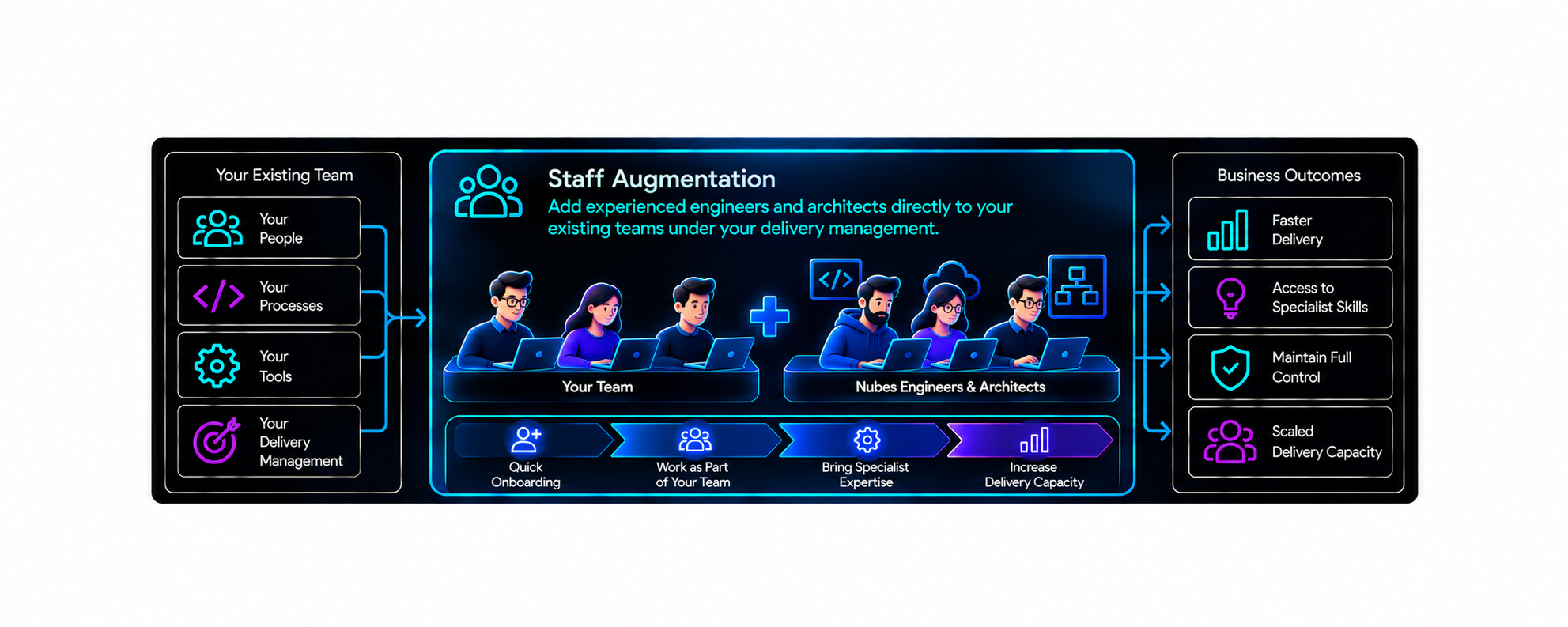
Add experienced engineers and architects directly to your existing teams under your delivery management.


Add experienced engineers without rebuilding your delivery model
Sometimes the team, architecture and priorities are already clear. The constraint is simply having enough experienced people to deliver the work.
We add engineers and architects directly to your existing teams, working inside your tools, processes and technical standards while your organization keeps control of priorities, management and delivery.
Typical scenarios:
The roadmap is growing faster than recruitment – internal hiring cannot add capacity quickly enough.
A team has a temporary capability gap – cloud, DevOps, SRE, platform or architecture skills are needed for a specific period.
A transformation creates a short-term demand peak – more experienced engineers are needed during migration, modernization or platform work.
You already have strong delivery leadership – you want additional engineers without handing the project or workstream to another provider.
How does Staff Augmentation work?
We identify the skills and experience your team is missing, add suitable engineers to your existing delivery structure and let your managers and technical leads direct their day-to-day work alongside internal team members.
What does Staff Augmentation include?
Staff augmentation should feel like adding capable people to your team, not creating another supplier workstream that has to be managed separately.

Add capability without giving away delivery control
Staff augmentation is most effective when responsibility is explicit.
Your organization owns the roadmap, task priorities, architecture direction and final delivery. The augmented engineers contribute their experience and execution capability inside that structure.
We focus on fitting the person to the actual technical work rather than treating engineering roles as interchangeable capacity.
We provide:
Role and capability matching
Experienced engineering and architecture specialists
Integration into existing teams and workflows
Continuity, scaling and replacement support

Benefits of Staff Augmentation
Frequently Asked Questions
What is IT Staff Augmentation?
Staff augmentation adds external specialists to an existing client team for an agreed period.
The engineers normally use the client’s tools and processes and receive day-to-day direction from the client’s engineering manager, technical lead or project manager.
The client keeps responsibility for priorities and the overall delivery outcome.
This is different from outsourcing a complete project, where the external provider is responsible for planning and delivering an agreed result. PMI explicitly separates directly managed external consultants from outsourced project delivery in this way.
What roles can you provide?
Our strongest fit is experienced technology roles close to our core consulting and engineering areas.
These can include:
- Cloud Engineers
- DevOps Engineers
- Platform Engineers
- Site Reliability Engineers
- Infrastructure Engineers
- Kubernetes Engineers
- Cloud Architects
- Solution Architects
- Technical Leads
- Senior Software Engineers
We define the profile around the actual work rather than only matching technology keywords.
Who manages the augmented engineers?
Your organization does.
Your engineering manager, project manager or technical lead normally controls priorities, tasks, sprint planning and acceptance of work.
Nubes remains responsible for the commercial relationship and the quality of the specialists we provide, but staff augmentation does not transfer overall delivery responsibility to us.
This distinction is important. Buying engineering capacity and expecting the supplier to own the project creates unclear accountability. Current staff-augmentation guidance consistently treats client management and provider-managed delivery as different engagement models.
How quickly can an engineer become productive?
That depends on the environment.
An experienced engineer may already know the technology, but still needs to learn your architecture, systems, standards, access model and business context.
We try to reduce ramp-up by matching people with relevant experience and agreeing responsibilities before they join.
How do you manage access and security for external engineers?
External engineers should receive only the access required for their role.
The exact process follows the client’s security model, but it can include approved identities, MFA, role-based access, time-limited permissions, access reviews and clear removal of access when the engagement ends.
Microsoft’s current guidance for external users recommends least-privilege access, controlled onboarding, access expiration and periodic reviews rather than giving contractors broad permanent access.
This is especially important for production, regulated data and administrative access.
Can we increase or reduce the team over time?
Yes.
Staff augmentation is useful when demand changes over the life of a program.
For example, a migration may initially need additional infrastructure and DevOps engineers, then require more SRE support during stabilization.
We can adjust individual roles as requirements change, while trying to preserve continuity where system knowledge matters.
When is Staff Augmentation not the right model?
It is usually a poor fit when the client does not have enough management capacity to direct the external engineers.
If there is no clear backlog, technical leadership or person responsible for delivery, adding more people can increase coordination without fixing the underlying problem.
In that situation, a Managed Delivery Team may be more appropriate because Nubes takes responsibility for team leadership and the defined workstream.
If the work has a clear endpoint and deliverables, Project-Based Outsourcing may be a better fit.
How is Staff Augmentation different from Senior Specialists & Technical Leads?
Both models can place one person inside your team, but the buying reason is different.
Staff Augmentation is mainly about adding engineering capacity or a known skill under your existing management.
Senior Specialists & Technical Leads is for situations where the missing element is deeper expertise, technical judgment or leadership around a difficult problem.
For example:
Adding another experienced DevOps engineer to an established platform team is Staff Augmentation.
Bringing in a senior platform architect to decide the target operating model and unblock several teams is Senior Specialists & Technical Leads.
Turn your Technology Challenge into a clear Delivery Plan
Nubes Consulting Digital helps design, modernize and operate complex technology environments. From Cloud and Architecture to DevOps, SRE and Engineering Delivery, we focus on practical decisions, reliable execution and measurable business outcomes.
