
Service
Enterprise Architecture
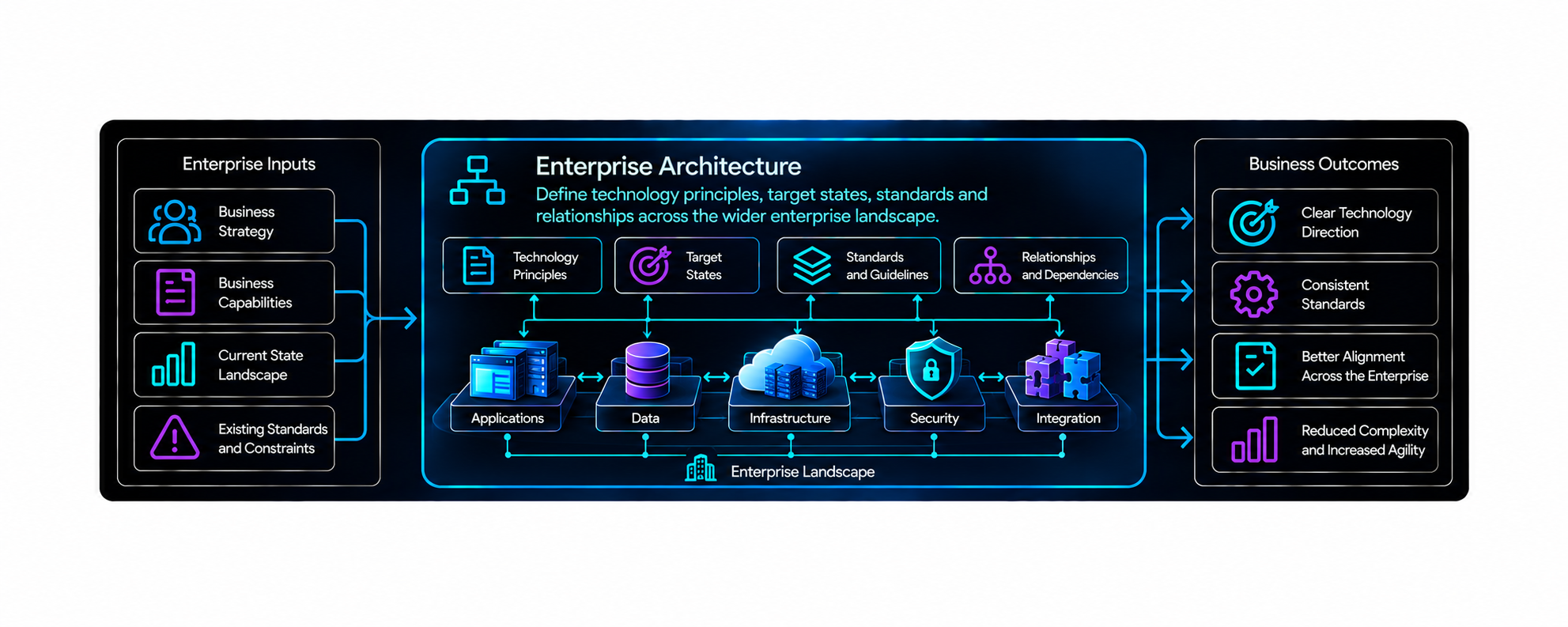
Define technology principles, target states, standards and relationships across the wider enterprise landscape.

Give the technology landscape a clear direction
Enterprise technology becomes difficult to control when applications, platforms and standards grow independently across business units, projects and years of change.
We help organizations understand the wider technology landscape, define target states and establish practical principles, standards and roadmaps that guide investment without creating unnecessary architecture bureaucracy.
Typical scenarios:
The technology estate has become fragmented – overlapping applications, platforms and integration patterns increase cost and complexity.
Major transformation programs need one direction – cloud, modernization, data and AI initiatives are making architecture decisions independently.
Standards exist but teams do not know when to use them – governance depends on documents and architecture committees rather than clear guidance.
The organization knows the current landscape must change – but there is no agreed target state or realistic sequence for getting there.
How does Enterprise Architecture work?
We connect business priorities with the current technology landscape, define the required target state and create principles, standards and transition roadmaps that guide future technology decisions.
What does Enterprise Architecture include?
Enterprise Architecture looks beyond one application or project. It creates a wider view of business capabilities, applications, data, technology and the relationships between them so change can be planned across the organization.

Make architecture a decision system, not a documentation library
Enterprise Architecture creates little value if diagrams are accurate but delivery teams still do not know what decisions to make.
We focus on the architecture information that changes investment and engineering decisions: which platforms should grow, which should be reduced, which standards should be shared and where exceptions are reasonable.
The target state provides direction. The roadmap makes that direction achievable.
We provide:
Enterprise landscape and capability mapping
Target architecture and transition roadmaps
Technology principles, standards and lifecycle guidance
Architecture governance and decision models

Benefits of Enterprise Architecture
Is your technology landscape growing faster than your ability to govern it?

Frequently Asked Questions
What is Enterprise Architecture?
Enterprise Architecture provides a structured view of how business capabilities, applications, data and technology fit together across an organization.
It helps answer larger questions such as:
Which technologies should become enterprise standards?
Which applications should remain strategic?
Where are several systems solving the same problem?
What should the technology landscape look like in three or five years?
What sequence of changes can realistically move the organization there?
The Open Group describes Enterprise Architecture as a holistic view that supports strategic decision-making across the wider organization rather than one individual solution.
How is Enterprise Architecture different from Solution Architecture?
The main difference is scope.
Enterprise Architecture looks across the wider organization. It defines target states, principles, standards, portfolios and relationships between many systems and programs.
Solution Architecture designs one specific business solution and explains how its applications, data, infrastructure, integrations and security work together.
Enterprise Architecture creates the direction. Solution Architecture applies that direction to a specific problem.
Do you use TOGAF?
Where it helps, yes.
TOGAF provides useful concepts for current and target architectures, roadmaps, principles, governance and architecture development.
But we do not treat framework compliance as the outcome.
The Open Group itself describes the current TOGAF Standard as configurable for different organizations, architecture practices and use cases.
We use the parts that help the organization make better decisions and avoid unnecessary process where they do not.
Do we need to document our entire technology estate first?
No.
Trying to document every server, interface and application before making any decisions can turn Enterprise Architecture into a multi-year inventory exercise.
We start with the scope relevant to the business decision.
That may mean mapping major business capabilities, strategic applications, important data domains, core platforms and significant dependencies first.
The architecture repository can then become more detailed where additional information creates decision value.
What is a target architecture?
A target architecture describes how an organization wants its technology landscape to evolve.
It can define future application boundaries, shared platforms, data models, integration patterns, infrastructure direction and technology standards.
The target state should not be treated as a fixed prediction of the future.
AWS recommends identifying a desired target state and then closing gaps iteratively as the organization learns and conditions change. Microsoft similarly recommends defining target states across architecture, operations and governance once strategic objectives are understood.
How do architecture principles and standards avoid slowing teams down?
Good standards reduce repeated decisions.
For example, teams should not need a committee meeting every time they need authentication, application logging or an API pattern if supported enterprise approaches already exist.
Principles define direction. Standards define commonly accepted choices. Guardrails can automate some controls. Exceptions remain possible when the workload has a real reason.
Thoughtworks recommends this kind of lightweight governance: use vision, principles and constraints to create direction while preserving team autonomy rather than mandating every implementation detail centrally.
Can Enterprise Architecture help us reduce application and technology sprawl?
Yes.
We can map applications to business capabilities and assess areas where several systems provide similar functionality.
Technology portfolios can also be reviewed for duplicated frameworks, unsupported platforms or products that no longer fit the target architecture.
That does not mean automatically removing every duplicate system.
Some duplication can be justified by regulation, geography, organizational structure or different business needs.
The purpose is to make those choices explicit rather than allow complexity to grow by accident.
How do you keep Enterprise Architecture useful after the initial work?
Architecture has to change with the organization.
We recommend clear ownership for important domains, lightweight decision records and regular reviews of standards, target states and technology lifecycles.
Architecture data can increasingly be connected to real delivery and operational systems instead of relying only on manually updated diagrams.
Thoughtworks describes this direction as moving from static architecture documentation toward structured architecture data, standards-as-code and continuous assessment so architecture can remain connected to changing technology environments.
Your own large-scale data-center migration also provides practical evidence for why this wider architecture view matters. The program required application and infrastructure landscape discovery, dependency and ownership mapping, migration patterns and enterprise-level architecture decisions across several parallel delivery teams.
Turn your Technology Challenge into a clear Delivery Plan
Nubes Consulting Digital helps design, modernize and operate complex technology environments. From Cloud and Architecture to DevOps, SRE and Engineering Delivery, we focus on practical decisions, reliable execution and measurable business outcomes.