
Service
Solution Architecture
Design complete solutions across applications, infrastructure, data, security and integration.


Design the complete solution before teams build separate parts of it
Enterprise solutions rarely fail because one component is completely wrong. Problems usually appear between components — where applications, data, infrastructure, security and integrations meet.
We design complete technical solutions around business requirements and real operational constraints, giving delivery teams a clear architecture for how the whole system should work together.
Typical scenarios:
A new business capability needs several systems to work together – applications, data, infrastructure and integrations need one technical design.
A major project is moving into implementation – teams need architecture decisions, interfaces and responsibilities before development scales.
Existing systems need to be combined or replaced – the target solution must work while old and new components coexist.
Different technical teams are designing independently – application, cloud, data and security decisions are starting to conflict.
How does Solution Architecture work?
We translate business and non-functional requirements into a complete technical design, define how components interact and document the decisions delivery teams need to implement the solution consistently.
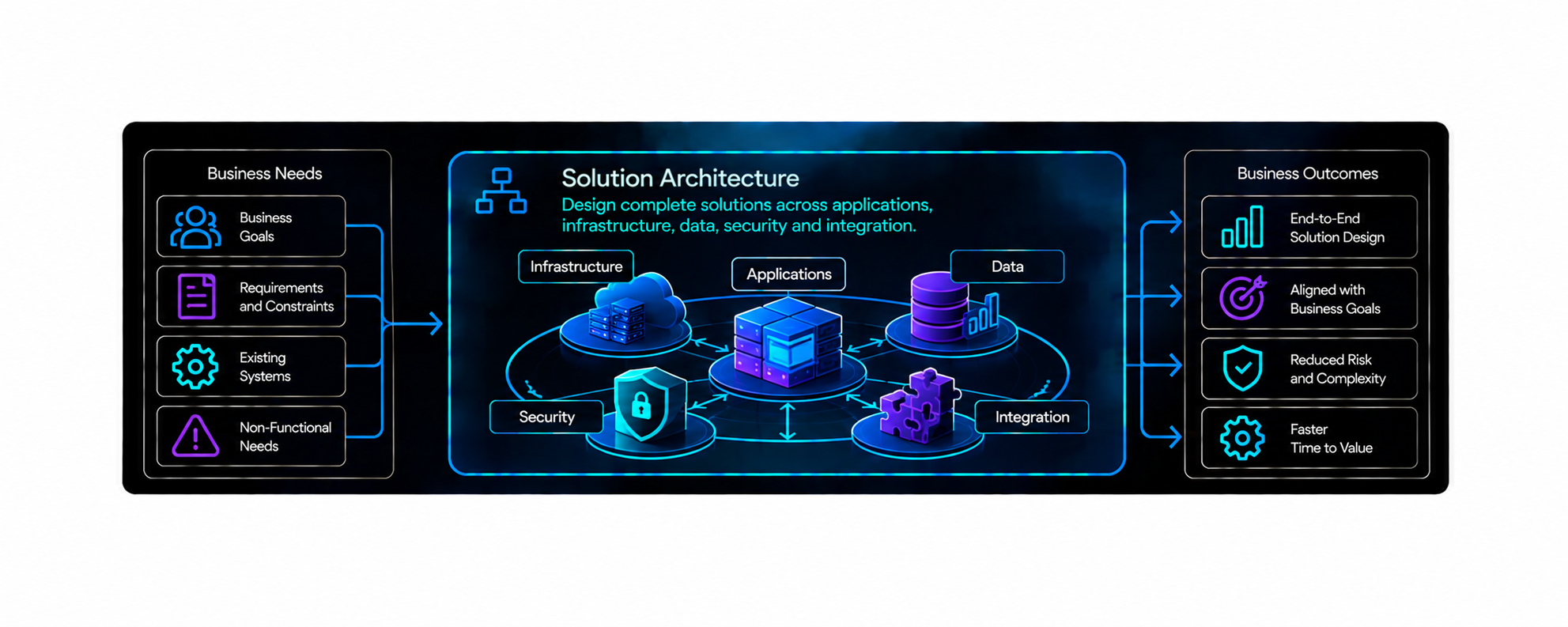
What does Solution Architecture include?
Solution architecture connects business requirements with practical technology choices. It defines not only which components are needed, but how applications, data, infrastructure, security and external systems work together through normal operations and failure scenarios.
Turn requirements into a design teams can actually build
Architecture should provide enough direction to keep teams aligned without trying to predict every implementation detail.
We define the important boundaries, contracts, technology decisions and quality requirements first. Where several options are valid, we make the trade-offs visible and record why one approach was selected.
The result becomes a practical plan of record for engineering — not just a diagram for a steering meeting.
We provide:
End-to-end solution architecture and diagrams
Application, data and integration design
Non-functional requirements and technology decisions
Architecture decision records and implementation roadmap

Benefits of Solution Architecture
Frequently Asked Questions
What is Solution Architecture?
Solution architecture defines how technology components work together to solve a specific business problem.
It can cover applications, infrastructure, databases, APIs, messaging, security, identity, external systems, deployment and operations.
The purpose is to turn requirements into a technical design that engineering teams can implement.
It sits between high-level business or enterprise architecture and detailed implementation inside individual components.
What information do you need before designing a solution?
We normally start with the business objective, users and main system flows.
Useful inputs include:
- functional requirements,
- availability and performance expectations,
- security and regulatory constraints,
- existing applications and data,
- integration requirements,
- infrastructure constraints,
- expected usage and growth,
- operational requirements,
- delivery timeline and budget.
Requirements do not need to be perfect before architecture starts. Architecture work often helps expose missing or conflicting requirements.
Microsoft recommends architecture as an iterative process involving business stakeholders, developers, testers, operations and product owners because requirements and technical trade-offs need to be refined together.
What is the difference between Solution Architecture and Cloud & Infrastructure Architecture?
Solution Architecture covers the complete technical solution: applications, data, integrations, infrastructure, security and operations.
Cloud & Infrastructure Architecture focuses specifically on where workloads run and how compute, networking, resilience, connectivity and infrastructure services should be designed.
For example, Solution Architecture may define that an order platform contains several application components, APIs, an event flow, customer data and external payment integration.
Cloud & Infrastructure Architecture would go deeper into where those components run, how environments connect and how infrastructure survives failure.
Do you also design APIs and integrations?
Yes.
Integration is often one of the most important parts of solution architecture because many enterprise solutions depend on existing systems, SaaS products and external partners.
We define where synchronous APIs, asynchronous events, messaging or other integration patterns make sense and establish clear contracts between systems.
The goal is not to use one integration style everywhere. Different business flows may need different consistency, latency and failure behaviour.
Google’s current integration portfolio itself separates APIs, events, workflows, data pipelines and application integration because they solve different communication problems rather than one universal pattern.
How do you design data as part of the solution?
We look at where data originates, who owns it, where it is stored, how it moves and which systems are allowed to change it.
Important decisions can include:
- data ownership,
- transactional boundaries,
- schemas and contracts,
- consistency requirements,
- replication,
- retention,
- privacy and access,
- reporting and analytics flows.
We avoid designing the application architecture first and treating data as an implementation detail later.
How do you include security in Solution Architecture?
Security requirements influence architecture from the start.
We look at identity, trust boundaries, authentication, authorization, sensitive data, encryption, network exposure, secrets, logging and operational access.
The exact controls depend on the workload and risk.
Current AWS guidance treats security as a core architecture quality alongside reliability and performance and connects it directly to business and regulatory requirements rather than treating it as a final review activity.
What architecture documents do you normally produce?
The exact set depends on the project, but it can include:
- solution context and component diagrams,
- application and integration architecture,
- data-flow diagrams,
- infrastructure and deployment architecture,
- security and trust boundaries,
- non-functional requirements,
- API and data-contract decisions,
- Architecture Decision Records,
- risks and assumptions,
- implementation sequence.
We keep the documentation focused on decisions engineering teams will actually need.
AWS recommends ADRs for decisions affecting structure, non-functional requirements, dependencies, interfaces and major technologies, with the context and consequences captured for future teams.
Can you stay involved during implementation?
Yes.
Solution architecture should not disappear once diagrams are approved.
We can continue through architecture checkpoints, engineering questions, decision changes and implementation assurance as teams turn the design into working software.
New information often appears during delivery. The architecture should be able to evolve without losing its original requirements and decision history.
Your published work at Privatoria is a good example of this end-to-end responsibility. The role covered product architecture, infrastructure and security design together with engineering implementation and operational control for a privacy platform containing VPN, Tor, encrypted communication, secure email, file transfer and storage capabilities.
Turn your Technology Challenge into a clear Delivery Plan
Nubes Consulting Digital helps design, modernize and operate complex technology environments. From Cloud and Architecture to DevOps, SRE and Engineering Delivery, we focus on practical decisions, reliable execution and measurable business outcomes.
