
Service
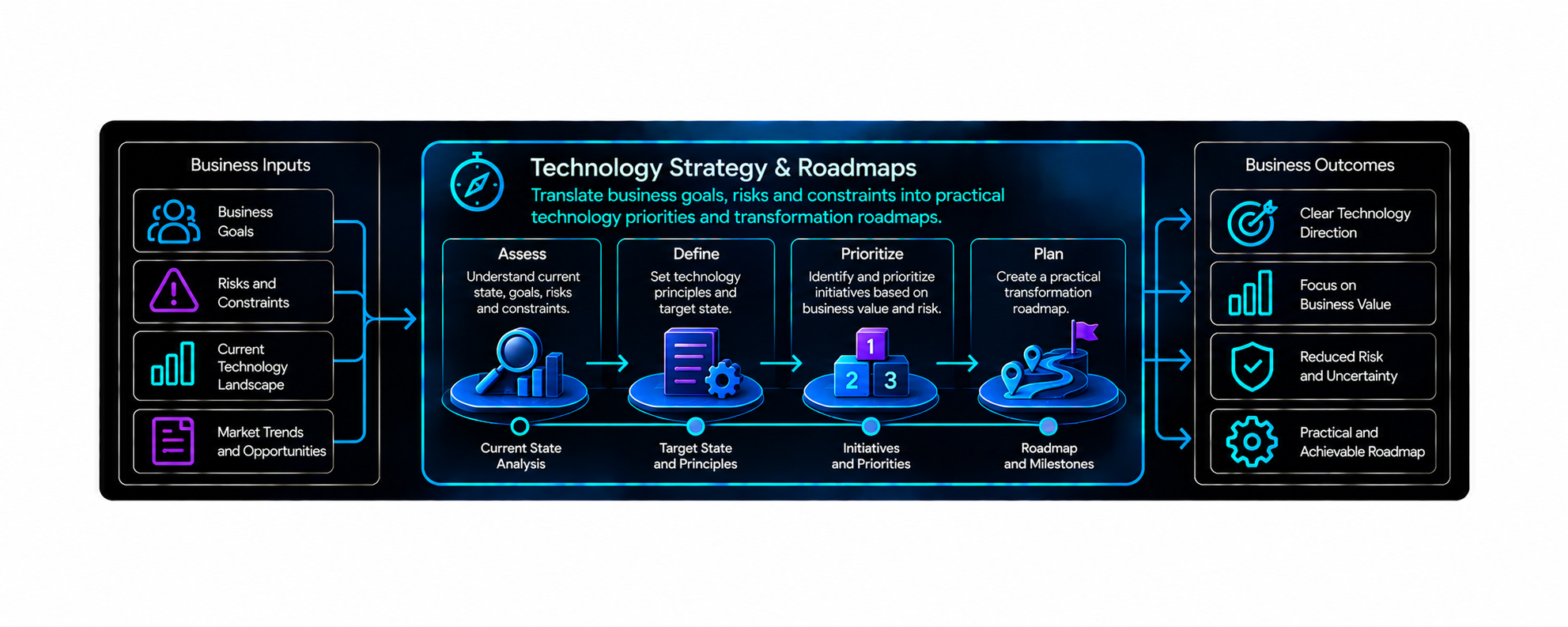
Technology Strategy & Roadmaps
Translate business goals, risks and constraints into practical technology priorities and transformation roadmaps.


Turn technology ambition into clear priorities
Most organizations do not suffer from a lack of technology initiatives. The harder problem is deciding which changes matter, which should happen first and where investment will create the most business value.
We translate business goals, risks and technical constraints into practical technology priorities and transformation roadmaps that leadership and engineering teams can use to make real decisions.
Typical scenarios:
Too many technology initiatives compete for the same budget – cloud, modernization, data, AI and security programs all appear important.
The business has changed but the technology plan has not – existing investments no longer match current priorities or risks.
Leadership knows major change is required – but there is no clear sequence, ownership or business case for getting from today to the target state.
Transformation programs depend on each other – architecture, infrastructure, applications and operating-model changes need one coordinated roadmap.
How do Technology Strategy & Roadmaps work?
We connect business objectives with the current technology estate, evaluate risks and constraints, then define priorities, investment choices and a sequenced roadmap with clear outcomes and decision points.
What does Technology Strategy include?
A useful technology strategy explains where technology should create value, what needs to change and what the organization should deliberately not prioritize yet. The roadmap then turns that direction into an executable sequence.
Build a roadmap around decisions, not dates alone
A roadmap should not pretend that every decision for the next three years can be made today.
We define the direction, near-term priorities and dependencies clearly, while keeping later choices open until the organization has enough evidence to make them well.
Each stage should produce a useful business or engineering outcome and create better information for the next decision.
We provide:
Technology strategy and investment priorities
Current-state constraints and strategic risk view
Target-state direction and transformation options
Sequenced roadmap, ownership and success measures

Benefits of Technology Strategy & Roadmaps
Frequently Asked Questions
What is a technology strategy?
A technology strategy explains how technology should support the organization’s business goals over time.
It connects areas such as applications, infrastructure, cloud, data, security, engineering and operations with outcomes such as growth, cost efficiency, resilience or faster delivery.
It should answer practical questions:
What needs to change?
Why does it matter?
What should happen first?
What should we stop doing?
How will we know the investment worked?
Microsoft describes the same principle as linking technology initiatives directly to measurable business objectives so investment trade-offs become explicit.
What is the difference between a technology strategy and a roadmap?
The strategy defines direction and priorities.
The roadmap describes how the organization moves in that direction.
For example, a strategy may decide that reducing dependence on unsupported legacy platforms is a priority.
The roadmap might then sequence application discovery, architecture decisions, platform preparation, modernization waves and retirement of the old environment.
A roadmap without strategy becomes a project list. Strategy without a roadmap remains an intention.
How is Technology Strategy different from Enterprise Architecture?
The two services work closely together but answer different questions.
Technology Strategy & Roadmaps asks:
What business outcomes matter?
Where should we invest?
Which technology changes have priority?
In what sequence should transformation happen?
Enterprise Architecture asks:
What should the wider technology landscape look like?
Which principles and standards should guide it?
How should applications, data and technology relate to each other?
Technology strategy decides where the organization should focus. Enterprise Architecture gives that direction a structured target state and standards.
How far into the future should a technology roadmap go?
Long enough to show direction, but not so far that the roadmap becomes fictional.
We can define a longer-term target direction while keeping the near-term roadmap much more detailed.
The next 90 days may contain specific decisions and actions. The following 6–18 months can be organized into initiatives and dependencies. Later stages are usually better expressed as outcomes and decision points until more evidence exists.
AWS recommends working from a longer-term business strategy but being prepared to pivot during execution rather than treating the roadmap as fixed.
How do you prioritize technology initiatives?
We evaluate initiatives against agreed decision criteria.
Depending on the organization, these can include:
- business value,
- customer impact,
- cost,
- resilience,
- security,
- regulatory deadlines,
- technical risk,
- dependency reduction,
- operational effort,
- skills availability,
- time to value,
- reversibility.
The aim is not to create an abstract score for every project. It is to make the important trade-offs visible enough for leadership to choose deliberately.
AWS’s transformation framework similarly recommends decomposing strategy into measurable business outcomes before prioritizing the roadmap.
Do you recommend technologies as part of the strategy?
Where necessary, yes, but we do not start by selecting products.
A strategy may establish that the organization needs stronger workload portability, better data integration or a common developer platform.
Specific products should then be evaluated against those requirements.
This distinction is important because technology selection made too early can turn the roadmap into a vendor adoption plan instead of a business technology strategy.
Your existing research supports the same position: platform tools should follow the destination and business decision rather than determine it.
Can the roadmap include legacy modernization, cloud, data and AI together?
Yes.
In many enterprises these areas cannot be planned independently.
For example, an AI initiative may depend on better data architecture. Application modernization may require a new platform. Cloud migration may expose an operating-model or resilience gap.
A useful roadmap makes those relationships visible so the organization does not start five transformation programs that all depend on the same unfinished foundation.
Microsoft specifically recommends alignment between business, digital, IT and adoption strategies because separate strategies can otherwise pull technology investment in different directions.
What do we receive from a technology strategy engagement?
The exact outputs depend on scope, but typically include:
- business and technology objectives,
- current-state constraints and risks,
- strategic technology priorities,
- target-state direction,
- investment and modernization options,
- dependency map,
- sequenced transformation roadmap,
- ownership and decision points,
- outcome measures,
- executive decision summary.
For larger transformation programs, the roadmap can then feed directly into Enterprise Architecture, Solution Architecture, Cloud & Infrastructure Architecture or continuing CTO Advisory & Technical Leadership.
Turn your Technology Challenge into a clear Delivery Plan
Nubes Consulting Digital helps design, modernize and operate complex technology environments. From Cloud and Architecture to DevOps, SRE and Engineering Delivery, we focus on practical decisions, reliable execution and measurable business outcomes.
