
Service
DevOps Transformation
Improve engineering processes, tooling and operating models to shorten and stabilize software delivery.

Improve how software moves from idea to production
Slow delivery is rarely caused by one missing tool. Delays usually build up across development, testing, security, infrastructure, approvals and operations.
We help organizations improve engineering processes, responsibilities and tooling so teams can deliver software faster, with fewer manual steps and more predictable production outcomes.
Typical scenarios:
Releases take weeks or months – changes spend more time waiting between teams than being developed.
DevOps exists, but every team works differently – tools and practices have grown without a common operating model.
Automation has not improved delivery speed – CI/CD and cloud investments exist, but manual gates and dependencies remain.
Growth is creating engineering friction – processes that worked for a few teams no longer scale across the organization.
How does DevOps Transformation work?
We measure the current delivery flow, identify the constraints that create delay or instability, and improve the operating model, engineering practices and automation around them.
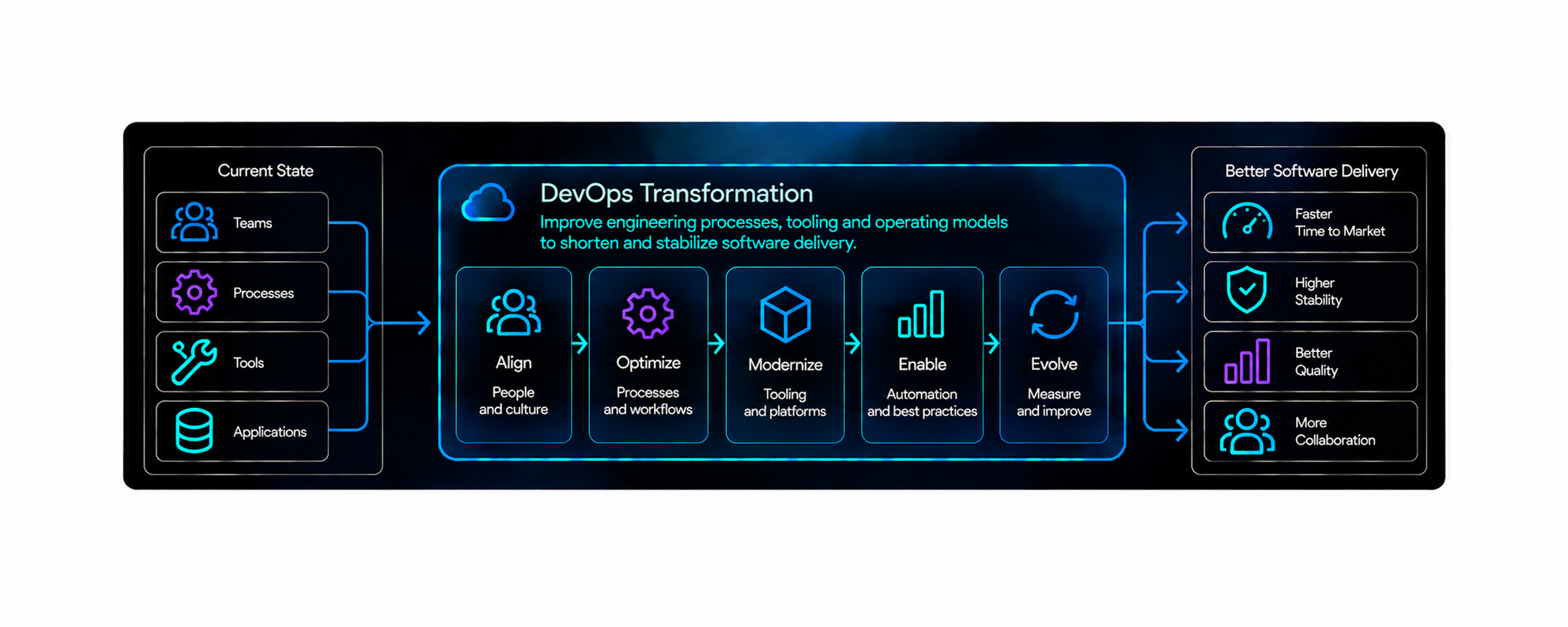
What does DevOps Transformation include?
DevOps Transformation improves how development, security, infrastructure and operations work together across the software lifecycle. The goal is not to make every team identical, but to remove avoidable waiting, manual handoffs and repeated engineering work.

Transform the delivery system, not the tool list
Buying a new CI/CD platform, Kubernetes or cloud service does not automatically make software delivery faster.
We start with the delivery outcome, measure where time and risk enter the process, and then decide whether the answer is automation, architecture, team ownership, platform capabilities or a simpler process.
Technology follows the constraint — not the other way around.
We provide:
DevOps maturity and delivery-flow assessment
Target operating model and ownership design
Engineering improvement roadmap
Transformation coaching and measurable implementation

Benefits of DevOps Transformation
Frequently Asked Questions
What is DevOps Transformation?
DevOps Transformation improves the way software is planned, built, tested, deployed and operated.
It usually involves changes to team responsibilities, engineering practices, automation, architecture, governance and measurement.
DevOps is not one product or one team. Microsoft defines it as the combination of people, process and technology across the complete application lifecycle.
How do you know where to start?
We start by measuring the current delivery system.
We look at how code reaches production, where work waits, how often teams depend on other teams, what remains manual and where failures or rework occur.
Value-stream mapping and delivery metrics help turn a general statement such as “releases are too slow” into specific constraints that can be improved. DORA recommends this evidence-first approach rather than trying to improve every capability at once.
Which DevOps metrics should we measure?
DORA currently uses five software-delivery performance metrics:
- Change lead time — how long a code change takes to reach production.
- Deployment frequency — how often changes are deployed.
- Failed deployment recovery time — how quickly teams recover from a failed deployment.
- Change fail rate — how often deployments require immediate intervention.
- Deployment rework rate — how much deployment activity is unplanned work caused by production problems.
Together they show both delivery throughput and instability.
We can combine these with reliability, developer-experience and business measures where they provide useful context.
Is DevOps Transformation mainly about CI/CD automation?
No.
CI/CD is an important capability, but software delivery can remain slow even with excellent pipelines.
Manual approvals, tightly coupled systems, unclear ownership, slow test environments, security queues or dependencies on central teams can still block delivery.
DORA identifies capabilities across architecture, culture, testing, observability, deployment automation and team design as contributors to software-delivery performance.
Where CI/CD itself is the main constraint, that work can continue through our CI/CD & DevSecOps service.
Do all teams need to follow the same DevOps process?
No.
Consistency is useful for common areas such as security, artifact management, infrastructure controls and production visibility.
But different applications can have different risk, runtime and release requirements.
We standardize reusable capabilities and expectations while allowing teams enough autonomy to deliver effectively.
Microsoft describes this balance as alignment plus autonomy, while DORA research supports team structures that let teams test and deploy with fewer external dependencies.
Does DevOps Transformation require microservices or Kubernetes?
No.
DevOps practices can improve delivery for monoliths, microservices, mainframes, virtual machines, containers and other technology models.
DORA explicitly states that continuous delivery applies to contexts ranging from distributed systems and infrastructure configuration to database changes and mainframe software.
Architecture should support the delivery needs of the organization, not be changed simply to match a DevOps trend.
How do you improve collaboration between development and operations?
We reduce the conditions that create unnecessary handoffs.
That can include clearer service ownership, shared delivery goals, common telemetry, production feedback for developers, reusable platform capabilities and more automation around routine operational work.
Microsoft emphasizes shared ownership, accountability and continuous learning as core parts of an effective DevOps culture.
The aim is not simply to ask teams to “collaborate more.” The delivery system should require less coordination for routine changes.
How do you make DevOps Transformation last after the consulting engagement?
We avoid creating a process that depends on Nubes to operate it.
Transformation should leave internal teams with measurable delivery practices, clear ownership, reusable engineering capabilities and a way to identify the next constraint themselves.
We normally begin with a baseline, introduce improvements through real teams and workloads, measure the result, and then scale patterns that prove useful.
AWS recommends the same principle for enterprise transformation: build lasting internal capabilities, standardize proven ways of working and make continuous improvement part of normal operations rather than treating transformation as a one-time program.
Turn your Technology Challenge into a clear Delivery Plan
Nubes Consulting Digital helps design, modernize and operate complex technology environments. From Cloud and Architecture to DevOps, SRE and Engineering Delivery, we focus on practical decisions, reliable execution and measurable business outcomes.
