
Service
Cloud Exit & Repatriation
Move selected workloads from cloud to private infrastructure, colocation or another platform when economics or control require it.


Move the right workloads out of Cloud – for the right reasons
Public cloud is not always the best long-term home for every workload.
We help organizations repatriate selected applications and data to private cloud, colocation, on-premises or alternative infrastructure when cost, control, performance, sovereignty or operating requirements make a different placement more suitable.
Typical scenarios:
Cloud economics no longer work – stable workloads cost more than their business value justifies.
More infrastructure control is required – security, sovereignty or operational needs call for a different platform.
Data gravity and egress are expensive – large or predictable data flows make the current architecture inefficient.
Cloud dependency has become a risk – proprietary services or contracts limit future infrastructure choices.
How do Cloud Exit & Repatriation work?
We validate the business case, design the target platform, replace or adapt cloud-specific dependencies, move workloads in controlled waves and prove the new environment before source services are retired.
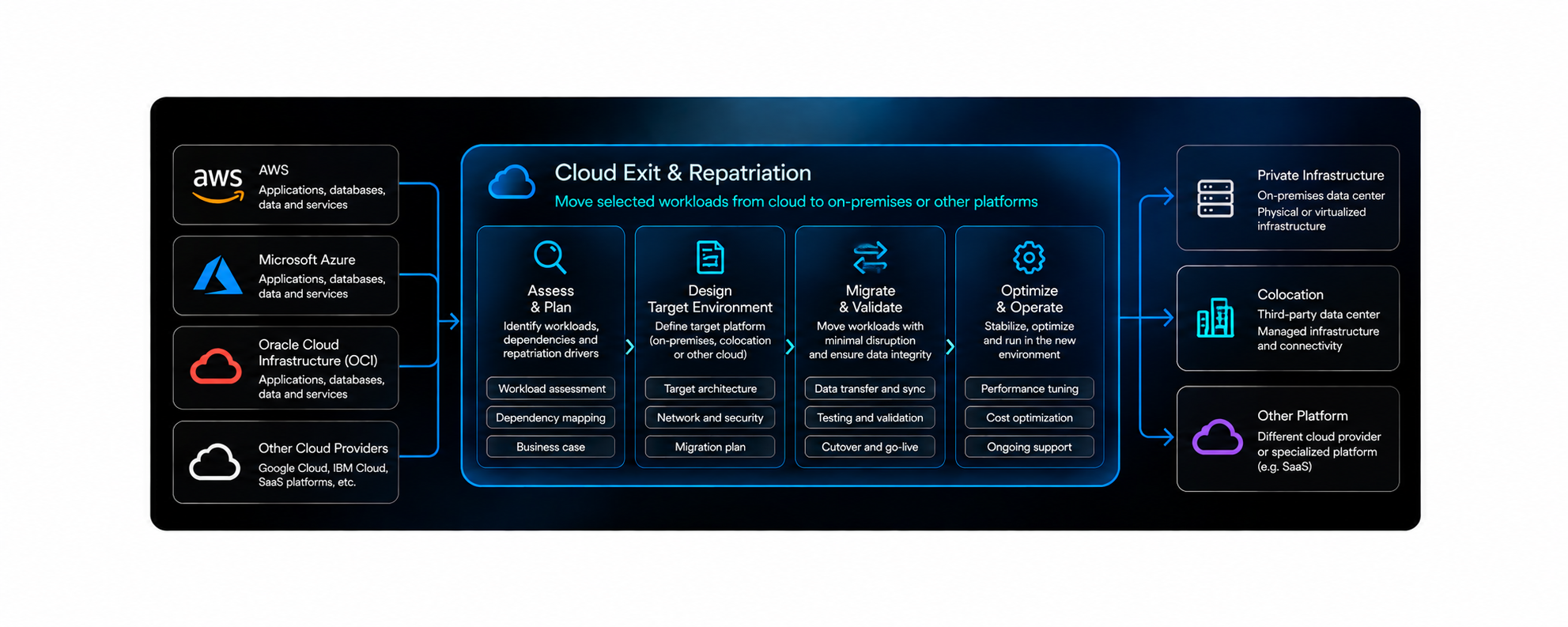
What does cloud repatriation include?
Cloud repatriation moves selected workloads from public cloud to private or alternative infrastructure. The challenge is not only moving compute and data, but also replacing cloud-native dependencies and rebuilding the operating capabilities the workload needs outside its current provider.
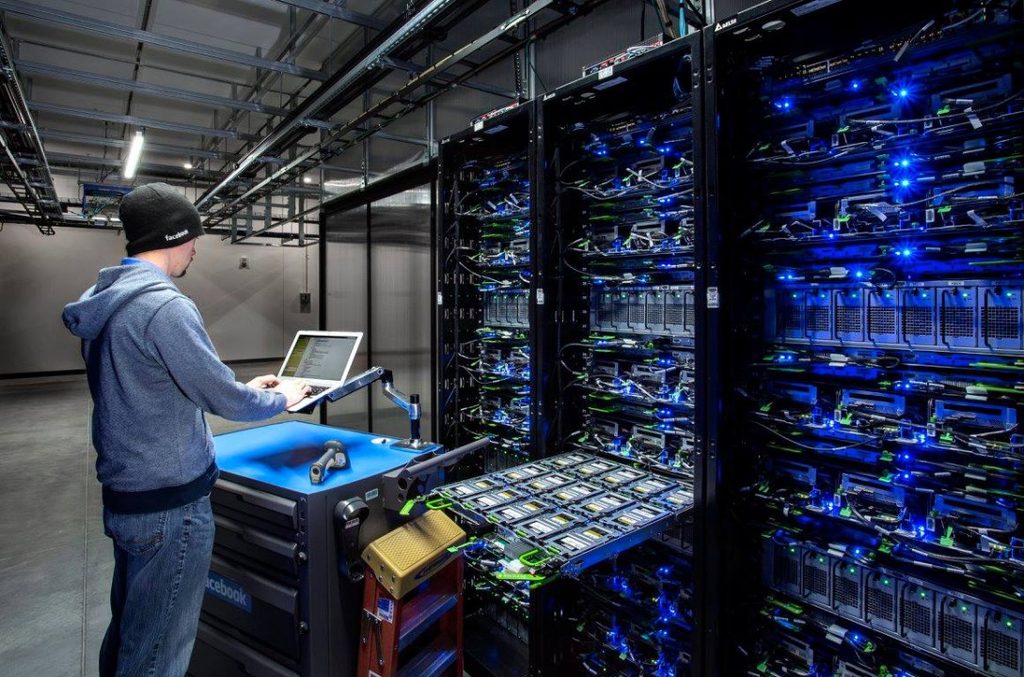
Repatriate workloads, not old problems
Moving out of public cloud should not mean rebuilding yesterday’s data center.
We design the target around current workload needs, automate infrastructure where practical and include capacity, backup, monitoring, security and operations from the start.
The business case also includes the cost of getting there — not only the future hosting bill.
We provide:
Repatriation architecture and TCO validation
Cloud dependency and portability analysis
Data migration, cutover and rollback planning
Target operations and source-cloud decommissioning

Benefits of Cloud Exit & Repatriation
Frequently Asked Questions
What is cloud repatriation?
Cloud repatriation is the movement of applications, data or infrastructure from public cloud to another operating environment.
This may include private cloud, colocation, company-owned infrastructure or a managed platform.
It is normally selective rather than a complete cloud exit. Public cloud can remain the right platform for workloads that benefit from elasticity, global reach or provider-managed services.
How do we know which workloads should leave cloud?
We look at workloads individually.
Important factors include utilization, growth pattern, data volume and movement, performance, resilience, regulatory requirements, cloud-specific dependencies, operating skills and total cost over several years.
Stable and predictable workloads can produce very different economics from highly variable applications.
The decision should be based on workload evidence rather than a company-wide “cloud versus on-premises” policy. IBM similarly promotes workload placement based on TCO, resilience, performance, security and regulatory needs.
Does cloud repatriation always reduce costs?
No.
The correct comparison includes more than the current cloud bill.
Private or colocated infrastructure introduces hardware or service commitments, software, networking, facilities, support and operating-team costs. Repatriation also creates one-time migration, data-transfer and parallel-running costs.
We model both the transition and steady-state economics before treating cost reduction as a reason to move.
Your own cloud-exit economics work follows exactly this approach, including CapEx, staffing, dual environments and retained services in the ROI calculation.
What happens to cloud-native services during repatriation?
They need to be assessed individually.
Virtual machines and standard databases may have relatively direct target options. Serverless functions, proprietary databases, queues, identity integrations and provider-specific APIs can require replacement or application changes.
We identify these dependencies before execution and decide whether to replace, replatform or retain them in cloud as part of a hybrid architecture.
Do we need to build our own data center?
No.
Repatriation does not mean returning to company-owned server rooms.
A target can be colocation, managed private cloud, hosted bare metal, a sovereign or regional provider, or a hybrid model where some services remain in public cloud.
Current industry discussion increasingly treats repatriation as workload placement rather than a return to traditional infrastructure.
How do you migrate large amounts of data out of cloud?
We plan data movement around volume, change rate, network capacity, source-provider charges and required RPO.
A typical migration may use an initial bulk copy followed by incremental synchronization until the final cutover.
For very large data volumes, the transfer strategy can be one of the most important parts of both the schedule and business case.
We also account for temporary duplicate storage and infrastructure while source and target environments operate together.
Does the EU Data Act affect cloud exit?
For organizations in the EU, it can be relevant.
The EU Data Act has applied since 12 September 2025 and includes rules intended to make switching between data-processing providers – and movement to on-premises ICT infrastructure – easier. It requires providers to address contractual and technical barriers to switching.
The European Commission also states that switching charges, including data-egress charges related to switching, are due to be fully removed from 12 January 2027, after the transitional period.
We can include technical switchability and portability in the architecture assessment, while legal interpretation remains with qualified legal counsel.
Can we reduce cloud dependency without leaving cloud completely?
Yes, and this can be the better option.
A company may replace selected proprietary services, change storage architecture, improve portability or keep a private copy of critical data while continuing to use public cloud for other capabilities.
This can improve negotiating leverage and make a future exit easier without creating the cost and risk of an unnecessary full repatriation.
Your existing Cloud Exit practice describes this intermediate approach as a practical way to reduce lock-in before deciding whether full exit is justified.
Turn your Technology Challenge into a clear Delivery Plan
Nubes Consulting Digital helps design, modernize and operate complex technology environments. From Cloud and Architecture to DevOps, SRE and Engineering Delivery, we focus on practical decisions, reliable execution and measurable business outcomes.
