
Service
Database Modernization
Modernize legacy databases, schemas, data access patterns and database platforms.

Modernize the data layer without putting the business at risk
Legacy databases often contain much more than data. Schemas, stored procedures, triggers, direct table access and years of business logic can make them one of the hardest parts of an application to change.
We modernize database platforms, schemas and data access patterns in controlled stages while protecting data integrity, application behaviour and production continuity.
Typical scenarios:
Database technology is reaching end of life – support, skills or licensing are becoming difficult to sustain.
A shared database blocks application modernization – teams cannot change or deploy services independently.
Performance and scale are becoming limits – the current platform or schema no longer fits workload demand.
Cloud or platform modernization requires a new data layer – applications need managed, open-source or purpose-built database services.
How does Database Modernization work?
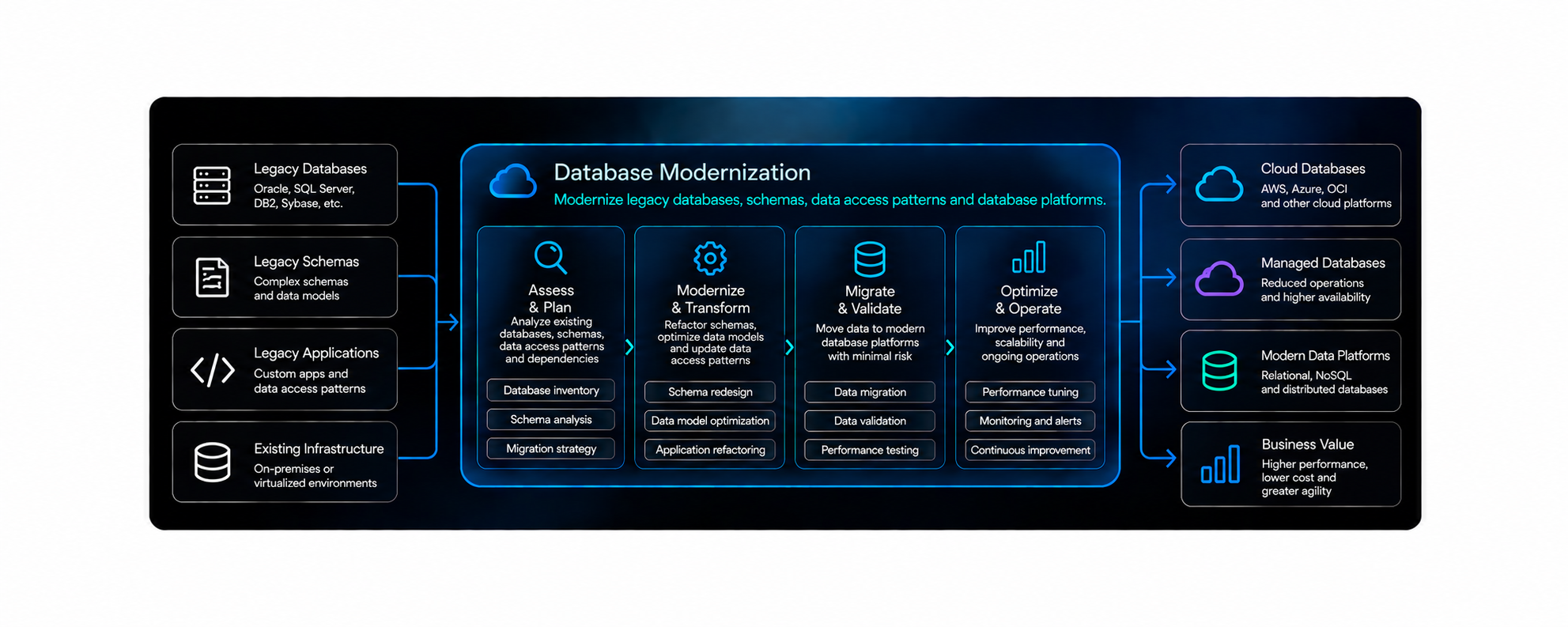
We assess database structure, code and access patterns, choose the right target strategy, migrate or reshape the data, and validate behaviour before production cutover.
What does database modernization include?
Database modernization can range from upgrading an existing engine to changing database technology or decomposing a shared data model. The right approach depends on application dependencies, business logic, performance, consistency and how much change the wider system can safely absorb.

Change the database only as far as the architecture needs
Not every legacy database needs to be replaced.
Sometimes the right step is an engine upgrade or managed version of the same platform. In other cases, licensing, scaling or application coupling justify a new engine, schema redesign or gradual database decomposition.
We choose the smallest change that creates the required long-term value.
We provide:
Database assessment and target architecture
Schema and database-code modernization
Data migration and synchronization
Access-pattern and database decomposition

Benefits of Database Modernization
Is the database becoming the hardest part of your application to change?

Frequently Asked Questions
What is database modernization?
Database modernization improves an existing database platform, schema, database code or access model so it better supports current applications and operating requirements.
It can include version upgrades, migration to a managed platform, changing database engines, schema redesign, decomposition of a monolithic database or changes to how applications access data.
It does not always require replacing the existing database.
How is database modernization different from database migration?
Database migration focuses mainly on moving a database from one environment or platform to another.
Database modernization can go further. It may change the database engine, schema, stored logic, data ownership or application access patterns.
For example, moving Oracle to another Oracle environment can be primarily a migration. Moving Oracle to PostgreSQL while changing procedures and application queries is a modernization program.
Google similarly distinguishes database migration from simple data movement because the database includes schema objects and executable logic as well as data.
Do we need to change database engine?
No.
If the current engine still fits the workload, modernization may mean upgrading versions, moving to a managed service, improving availability or redesigning schemas and operational processes.
Changing engines introduces more work because SQL dialects, data types, procedures, functions and platform behaviour can differ.
We recommend heterogeneous migration only when the technical or commercial benefit justifies that additional change.
What happens to stored procedures, triggers and database business logic?
We inventory and classify them before deciding how they should move.
Some logic can be converted directly. Some needs redesign for the target database. Other business logic may be better moved from the database into application services as part of a wider architecture modernization.
AWS’s current database-decomposition guidance explicitly treats moving business logic from procedures, triggers and functions into application services as a separate modernization activity that requires analysis and rollback planning.
Can you modernize a shared monolithic database?
Yes, but it should normally be done incrementally.
Shared databases often contain hidden dependencies between applications, schemas and teams. Splitting them too early can create data-consistency and transaction problems.
We first identify data ownership and access patterns, then introduce boundaries and move suitable domains gradually.
AWS notes that a shared database creates both development and runtime coupling, while Microsoft highlights data ownership, schema decomposition, joins and integrity as key challenges during microservice modernization.
How do you migrate databases with minimal downtime?
Where the database technology supports it, we can combine an initial data load with ongoing replication or change data capture.
The source continues processing changes while the target catches up. Before cutover, we reduce the remaining difference, validate the target and switch applications during an agreed window.
The exact approach depends on transaction rate, database technology, consistency requirements and RPO/RTO.
AWS DMS and Azure Database Migration Service both support online migration patterns designed to reduce application downtime.
How do you validate that the migrated data is correct?
We define validation before migration rather than relying only on whether the migration tool reports success.
Depending on the workload, this can include row counts, totals, referential integrity, schema checks, application queries and business-level reconciliation.
The Nubes modernization research recommends this same approach for data migration: source-to-target mappings and anomaly rules should be reviewed by data owners, followed by reconciliation of counts, sums and referential integrity.
For critical systems, application owners also validate that the data has the same business meaning after migration.
Should every microservice have its own database?
Not automatically.
Separate data ownership can improve independence, but decomposing a database also creates distributed-data concerns such as consistency, synchronization and cross-service transactions.
We align database boundaries with business domains where independent ownership provides real value and use shared or transitional patterns where a complete split would create unnecessary complexity.
AWS explicitly notes that separate databases are not mandatory in every situation and that shared schemas may remain appropriate during staged modernization.
Turn your Technology Challenge into a clear Delivery Plan
Nubes Consulting Digital helps design, modernize and operate complex technology environments. From Cloud and Architecture to DevOps, SRE and Engineering Delivery, we focus on practical decisions, reliable execution and measurable business outcomes.