
Service
Monolith to Microservices
Decompose tightly coupled systems into independently deployable services using incremental modernization patterns.


Break the monolith without breaking the business
Large monolithic applications often become difficult to change because code, data, releases and teams depend too heavily on each other.
We decompose tightly coupled systems into clearer business capabilities and independently deployable services using incremental modernization patterns that allow legacy and modern components to coexist during the transition.
Typical scenarios:
Release cycles are too slow – small changes require testing and redeploying a large application.
Teams block each other – several teams depend on the same codebase, database and release process.
Only part of the application needs to scale – but the whole monolith has to scale with it.
A full rewrite is too risky – business functionality must continue while architecture changes step by step.
How does Monolith to Microservices modernization work?
We identify business boundaries and dependencies, establish the target platform and gradually extract suitable capabilities while the existing application remains operational.
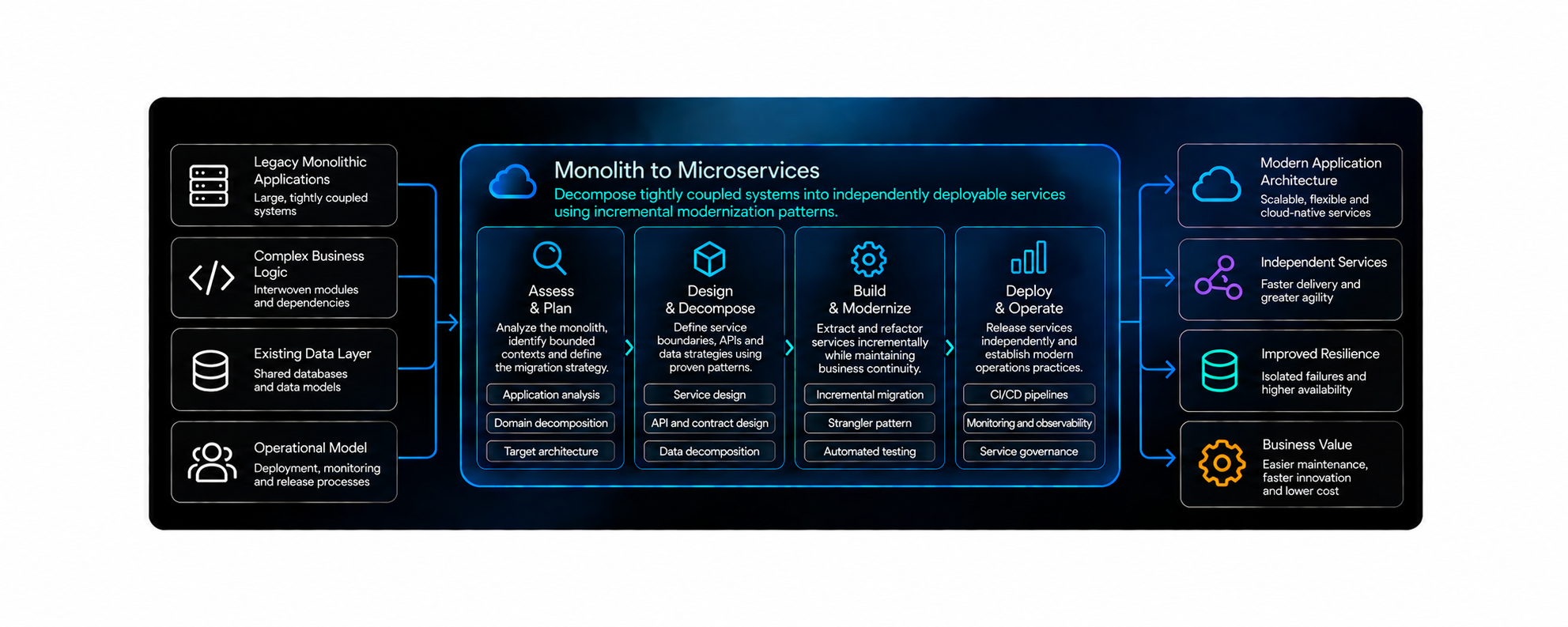
What does monolith decomposition include?
Successful microservices are defined by business boundaries and independent ownership, not by the number of services. We first understand domains, data and dependencies, then decide which parts should remain together and which can safely evolve on their own.

Modernize incrementally instead of rewriting everything
A big-bang rewrite creates a long period where the old system still runs but the new system produces little business value.
We prefer to extract one useful capability at a time, route traffic gradually to the new service and keep rollback possible while the architecture evolves.
Some parts may remain in the monolith permanently if splitting them adds more complexity than value.
We provide:
Domain and service-boundary assessment
Strangler Fig and coexistence architecture
API, event and data decomposition
Platform, CI/CD and operational enablement

Benefits of Monolith to Microservices Modernization
Frequently Asked Questions
What is monolith to microservices modernization?
It is the gradual decomposition of a larger application into smaller services that own clear business capabilities and can be developed, deployed and operated independently.
The goal is not simply to create more applications.
The goal is to reduce unnecessary coupling so teams can change important parts of the system with less coordination and risk.
Should every monolith be converted to microservices?
No.
Microservices introduce network communication, distributed data, observability, deployment and operational complexity.
A well-designed modular monolith can be the better architecture when the application does not need independent scaling, deployment or team ownership.
Thoughtworks specifically recommends modular monoliths in situations where the domain is still evolving or the additional operating complexity of microservices is not justified.
We recommend decomposition only where the expected business or engineering benefit is greater than that added complexity.
How do you decide where service boundaries should be?
We start with the business domain rather than technical layers.
Domain-driven design helps identify bounded contexts such as orders, pricing, invoicing or customer management. We then examine code dependencies, data ownership, release cadence, scaling needs and team structure.
A good boundary allows a service to change and deploy independently.
If two proposed services constantly call each other or always have to be released together, the boundary is probably wrong. Microsoft uses exactly these tests in its current microservice-boundary guidance.
What is the Strangler Fig pattern?
The Strangler Fig pattern modernizes an application gradually.
A routing or abstraction layer directs some requests to the existing monolith and others to newly extracted services. As more functionality moves, the responsibilities of the monolith become smaller.
After the old functionality has no remaining dependencies, it can be retired.
AWS and Microsoft both recommend this pattern for reducing the risk of large brownfield modernization programs.
What happens to the monolithic database?
This is often one of the hardest parts of the program.
Microservices should ideally own their domain data, but splitting a shared database too early can create difficult consistency and migration problems.
We first identify data ownership and access patterns. Depending on the situation, services may temporarily share existing data, use APIs around it or move domain data gradually using replication and change data capture.
Microsoft explicitly treats data ownership, schema decomposition, joins and integrity as major considerations during monolith decomposition.
Do we need Kubernetes to use microservices?
No.
Microservices are an architecture style, not a Kubernetes requirement.
Services can run on Kubernetes, container platforms, serverless services, virtual machines or other runtimes.
Kubernetes can be useful when many independently deployable services need consistent scheduling, scaling and operational controls, but the runtime should follow the workload and operating model rather than define the architecture.
What platform capabilities should exist before decomposition?
Independent services need a reliable path to production.
That normally includes CI/CD, environment provisioning, identity, secrets, monitoring, logging, security controls and a clear production support model.
Without these shared capabilities, application decomposition can create operational fragmentation.
This is directly supported by your SIXT engagement: the monolith-to-microservices program required a shared Kubernetes runtime, common CI/CD, monitoring and security architecture so extracted services had a consistent production platform.
How do you choose the first service to extract?
We normally choose a capability with a clear business boundary, manageable dependencies and enough value to prove the modernization approach.
Edge capabilities with fewer dependencies can be good first candidates.
Microsoft recommends starting with such services because they are easier to separate and allow teams to validate the architecture and operating model before tackling deeply coupled domains.
The first extraction should prove more than code decomposition. It should prove deployment, monitoring, data handling, support and coexistence with the monolith.
Turn your Technology Challenge into a clear Delivery Plan
Nubes Consulting Digital helps design, modernize and operate complex technology environments. From Cloud and Architecture to DevOps, SRE and Engineering Delivery, we focus on practical decisions, reliable execution and measurable business outcomes.
