
Service
Kubernetes & Container Platforms
Design and operate production Kubernetes and container platforms across cloud and hybrid environments.

Run containers on a platform built for production
Kubernetes can standardize how applications run, but production platforms also need networking, security, observability, delivery automation, scaling and lifecycle management.
We design and operate Kubernetes and container platforms across cloud, private and hybrid environments so application teams get a reliable runtime without having to solve the same infrastructure problems themselves.
Typical scenarios:
Containers are moving into production – the current cluster was built for development and needs a production operating model.
Every team runs Kubernetes differently – security, deployment and monitoring standards vary between projects.
Cluster operations consume too much engineering time – upgrades, scaling and platform maintenance depend on manual work.
Hybrid or multi-cloud workloads need a common runtime – applications need consistent container operations across different infrastructure environments.
How do Kubernetes & Container Platforms work?
We combine Kubernetes, networking, security, delivery automation and observability into a supported runtime that development teams can use consistently across applications and environments.
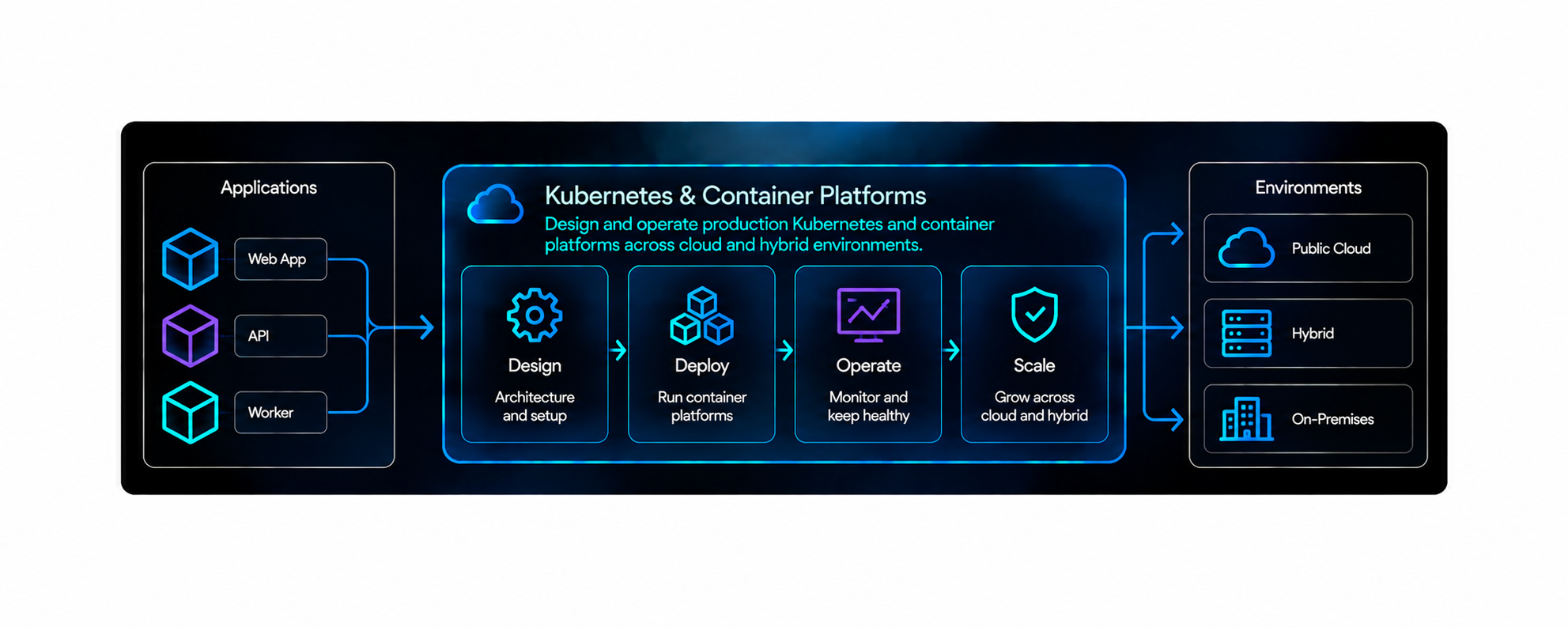
What does a production Kubernetes platform include?
A Kubernetes platform is more than the control plane and worker nodes. It provides the shared capabilities required to deploy, isolate, observe, scale and operate workloads safely throughout their lifecycle.
Design the platform around the workloads — not Kubernetes itself
Not every workload needs its own cluster, and not every organization should operate Kubernetes in the same way.
We choose managed or self-managed platforms, cluster boundaries, tenancy and automation based on workload criticality, security, team structure and operational capability.
The goal is to use Kubernetes where it simplifies application operations — not introduce another layer of infrastructure complexity.
We provide:
Kubernetes and container platform architecture
Security, networking and multi-tenancy design
GitOps, CI/CD and platform automation
Upgrades, observability and operational readiness

Benefits of Kubernetes & Container Platforms
Running Kubernetes, but still treating every cluster as a separate project?

Frequently Asked Questions
What is a Kubernetes platform?
A Kubernetes platform combines Kubernetes with the services and processes required to run applications safely in production.
This normally includes networking, access control, security, deployment automation, observability, resource management and platform operations.
Kubernetes provides the orchestration engine. The platform turns it into a usable production environment for engineering teams.
Which Kubernetes platforms do you support?
We are cloud and infrastructure agnostic.
We can work with managed services such as Amazon EKS, Azure Kubernetes Service and Google Kubernetes Engine, as well as Kubernetes distributions and platforms running on private, hosted or hybrid infrastructure.
The decision should depend on workload requirements, existing infrastructure, operational skills and how much of the Kubernetes lifecycle your organization wants to manage itself.
Microsoft now explicitly separates more managed AKS operating modes from configurations where organizations retain deeper platform control, reflecting this same trade-off.
Should we use managed Kubernetes or operate it ourselves?
Managed Kubernetes is often the better choice when there is no business value in operating the control plane yourself.
It can reduce work around availability, upgrades and underlying infrastructure.
Self-managed or more configurable platforms can still make sense when you need specific networking, infrastructure, security or sovereignty controls.
We compare those needs before selecting the operating model rather than assuming one model fits every environment.
Do we need one Kubernetes cluster or many?
It depends on isolation, scale, availability and organizational needs.
A shared cluster can reduce operating cost and duplicated infrastructure. Namespaces, RBAC and quotas can separate teams and workloads.
Separate clusters can provide stronger boundaries for critical workloads, environments or tenants, but increase lifecycle and management overhead.
The Kubernetes project recommends making this decision based on the required isolation level rather than following one universal cluster model.
How do you secure Kubernetes platforms?
Security starts with limiting access to the platform and workloads.
We can design identity integration, RBAC, service accounts, secrets, network policies, admission controls, image policies and workload isolation according to the environment.
For shared platforms, quotas and network controls are particularly important because one workload should not be able to consume another team’s resources or communicate with it without an explicit reason.
Kubernetes recommends least-privilege access, RBAC, resource controls and network isolation as key parts of secure multi-tenant environments.
Do you use GitOps for Kubernetes?
Where it fits the operating model, yes.
GitOps keeps desired application and platform configuration in version control and uses automation to reconcile that configuration with the running environment.
This provides reviewable changes, clearer configuration history and an easier way to reproduce or recover environments.
Google recommends GitOps for Kubernetes infrastructure and application delivery, while Microsoft includes GitOps in its production AKS reference architecture.
How do you operate Kubernetes upgrades without disrupting applications?
We treat upgrades as a normal platform lifecycle activity rather than an emergency project.
Changes are tested in lower environments before production. Workload disruption budgets, compatibility, add-ons, node replacement and application behaviour are reviewed before rollout.
For larger estates, upgrades can move progressively across development, staging, canary and production environments.
Google explicitly recommends this staged approach so cluster changes can be validated before they reach critical workloads.
How is this different from Platform Engineering?
The two services are closely related but have different scopes.
Kubernetes & Container Platforms focuses on the production runtime: clusters, networking, security, workloads, scaling, observability and lifecycle.
Platform Engineering builds a wider developer-facing product around shared capabilities such as self-service provisioning, Golden Paths, CI/CD and developer workflows.
Kubernetes may be one runtime behind an internal developer platform, but the platform can also expose virtual machines, serverless services, databases and other infrastructure.
This distinction is important because Kubernetes should support the developer platform rather than become the platform’s entire purpose.
Turn your Technology Challenge into a clear Delivery Plan
Nubes Consulting Digital helps design, modernize and operate complex technology environments. From Cloud and Architecture to DevOps, SRE and Engineering Delivery, we focus on practical decisions, reliable execution and measurable business outcomes.