
Service
Managed Delivery Teams
Delegate defined workstreams to a Nubes Consulting-led engineering team with technical leadership and delivery accountability.

Delegate the workstream, not just the engineering capacity
Adding more engineers does not always solve a delivery problem. Someone still needs to organize the work, make technical decisions, manage dependencies and remain accountable for what the team delivers.
We provide Nubes Consulting-led engineering teams that take responsibility for defined technology workstreams, combining specialist engineering capability with technical leadership and delivery accountability.
Typical scenarios:
An important workstream needs its own delivery team – but building and managing it internally would slow the program.
External engineers already exist but ownership is fragmented – the client needs one team lead and one clear delivery responsibility.
The backlog will continue to evolve – the work is too dynamic for a fixed-scope project but still needs measurable outcomes.
Specialist delivery needs to continue for several months – platform, DevOps, SRE, migration or modernization work requires a stable team rather than short-term individual contractors.
How do Managed Delivery Teams work?
We agree the workstream, responsibilities and expected outcomes, build a senior-led team around them and manage technical execution, planning, quality and delivery while working closely with the client’s product and technology leadership.
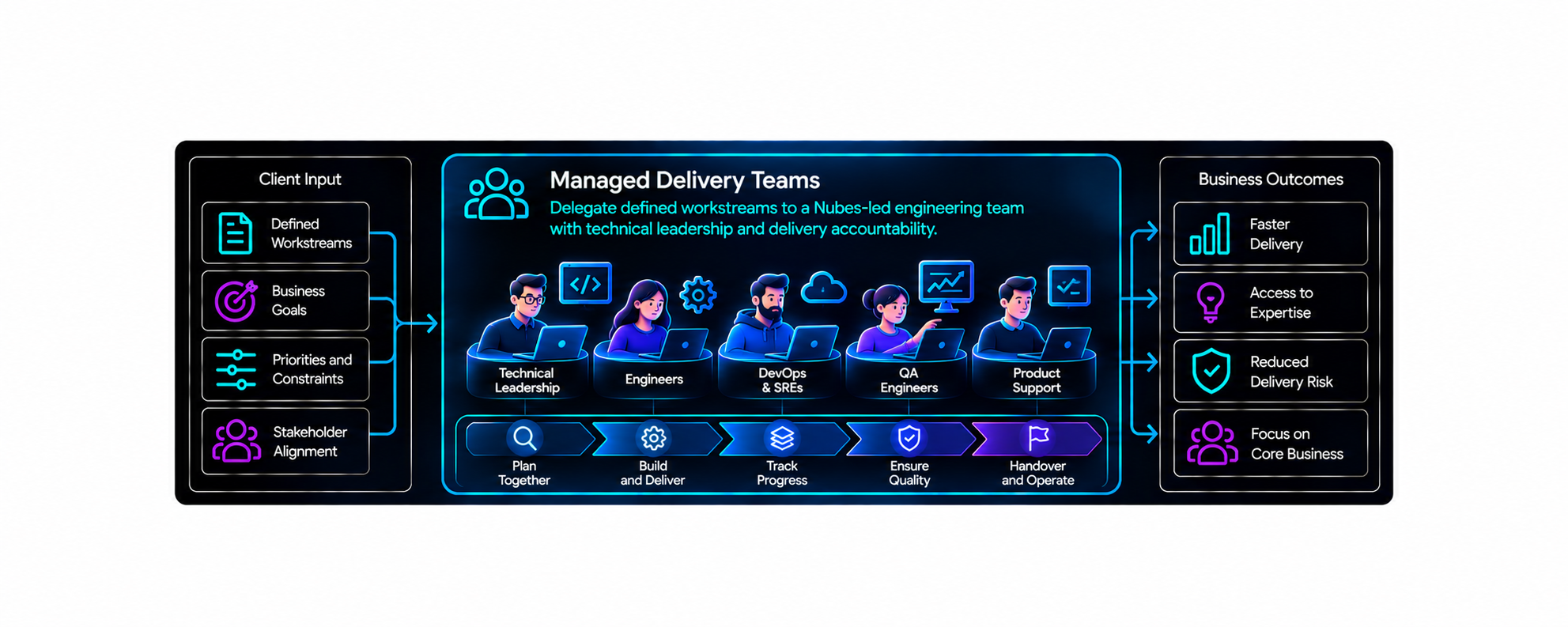
What does a Managed Delivery Team include?
The team is shaped around the work rather than a standard staffing package. It combines the engineering skills required for delivery with clear technical leadership and responsibility for turning priorities into working outcomes.

Give the team an outcome, not a queue of tickets
Managed delivery works best when the team understands what it is responsible for achieving, not only which tasks it should complete.
We agree the boundaries, success measures and decision rights, then give the team enough autonomy to plan and execute the technical work inside them.
Priorities can change. Accountability should not.
We provide:
Senior-led engineering team
Technical planning and architecture ownership
Delivery, risk and dependency management
Quality, documentation and operational handover

Benefits of Managed Delivery Teams
Frequently Asked Questions
What is a Managed Delivery Team?
A Managed Delivery Team is an external engineering team that takes responsibility for a defined area of technology delivery.
The team can include engineers, architects and specialist roles together with a technical lead responsible for day-to-day delivery.
The client normally defines business priorities and expected outcomes.
Nubes owns the technical execution required to turn those priorities into working results.
How is this different from Staff Augmentation?
The main difference is management and accountability.
With Staff Augmentation, individual specialists join your existing team. Your organization normally assigns their work, coordinates them and owns delivery.
With a Managed Delivery Team, Nubes provides the team structure, technical leadership and delivery management as part of the service.
You delegate a workstream rather than individual tasks to individual people.
How is this different from a Dedicated Engineering Team?
The models are close, but the responsibility level is different.
A Dedicated Engineering Team gives you a stable group of engineers for continuing work, usually operating under your product or engineering leadership.
A Managed Delivery Team includes stronger Nubes-side responsibility for technical direction, planning and delivery outcomes.
In simple terms:
Dedicated Team: you lead the team.
Managed Delivery Team: we lead delivery with you.
How is this different from Project-Based Outsourcing?
Project-Based Outsourcing has a defined project boundary and an expected endpoint.
The deliverables and acceptance conditions can normally be agreed before the project begins.
Managed Delivery is better for an ongoing workstream where priorities and backlog will evolve over time.
For example, building one defined platform can be a project.
Continuing to develop, improve and operate platform capabilities across several quarters is better suited to a managed team.
Who decides priorities?
The client normally retains ownership of business priorities.
For a platform team, for example, your organization may decide which engineering capabilities matter most and which internal users need support.
Nubes then translates those priorities into technical plans, sequencing and implementation.
We define this split clearly at the start so product responsibility and engineering responsibility do not become confused.
Team Topologies makes a similar distinction: autonomous teams still operate inside wider organizational goals and business priorities rather than choosing their mission independently.
What roles can be included in the team?
The team depends on the workstream.
It can combine roles such as cloud or solution architects, DevOps engineers, platform engineers, SREs, infrastructure engineers, application engineers and technical leads.
QA, security or other specialists can also be added where the work requires them.
We do not begin with a fixed pyramid of roles.
We build the smallest team that can reasonably own the agreed outcome.
How do you measure whether the team is performing well?
The measures should match the workstream.
Depending on the engagement, useful indicators can include delivery predictability, lead time, deployment frequency, completed capabilities, defect levels, reliability, incident reduction, automation coverage or operational improvements.
We also track delivery risks and dependencies that affect future commitments.
The goal is to measure what the team delivers and improves rather than simply how fully allocated every engineer is.
Can the team work with our internal teams and other suppliers?
Yes.
Managed teams often work as one part of a larger enterprise delivery model.
We define interfaces and responsibilities with client teams, platform groups, security, architecture and other vendors so dependencies are visible.
Where several teams need wider program-level coordination, our Delivery Leadership & Governance service can provide that control across the full program.
McKinsey’s research on product and platform operating models also stresses the importance of mechanisms for managing dependencies between autonomous teams rather than assuming that autonomy removes all coordination.
Turn your Technology Challenge into a clear Delivery Plan
Nubes Consulting Digital helps design, modernize and operate complex technology environments. From Cloud and Architecture to DevOps, SRE and Engineering Delivery, we focus on practical decisions, reliable execution and measurable business outcomes.
