
Service
API & Integration Modernization
Replace brittle point-to-point integration with modern APIs, events and reusable integration patterns.


Replace brittle integrations without replacing every system
Legacy applications often depend on custom interfaces, direct database access and point-to-point connections that become harder to change with every new project.
We modernize integration around reusable APIs, messaging and events so legacy and modern systems can work together without creating another generation of tightly coupled dependencies.
Typical scenarios:
Point-to-point integrations are growing – every new system needs another custom connection.
Legacy systems block new digital services – valuable data and business functions are difficult to expose safely.
Changes break downstream applications – consumers depend too closely on internal system behaviour.
Modernization is happening gradually – old and new applications need to operate together during the transition.
How does API & Integration Modernization work?
We map existing interfaces and dependencies, define stable service contracts, and replace one-off connections with reusable APIs, events and integration patterns that can evolve over time.
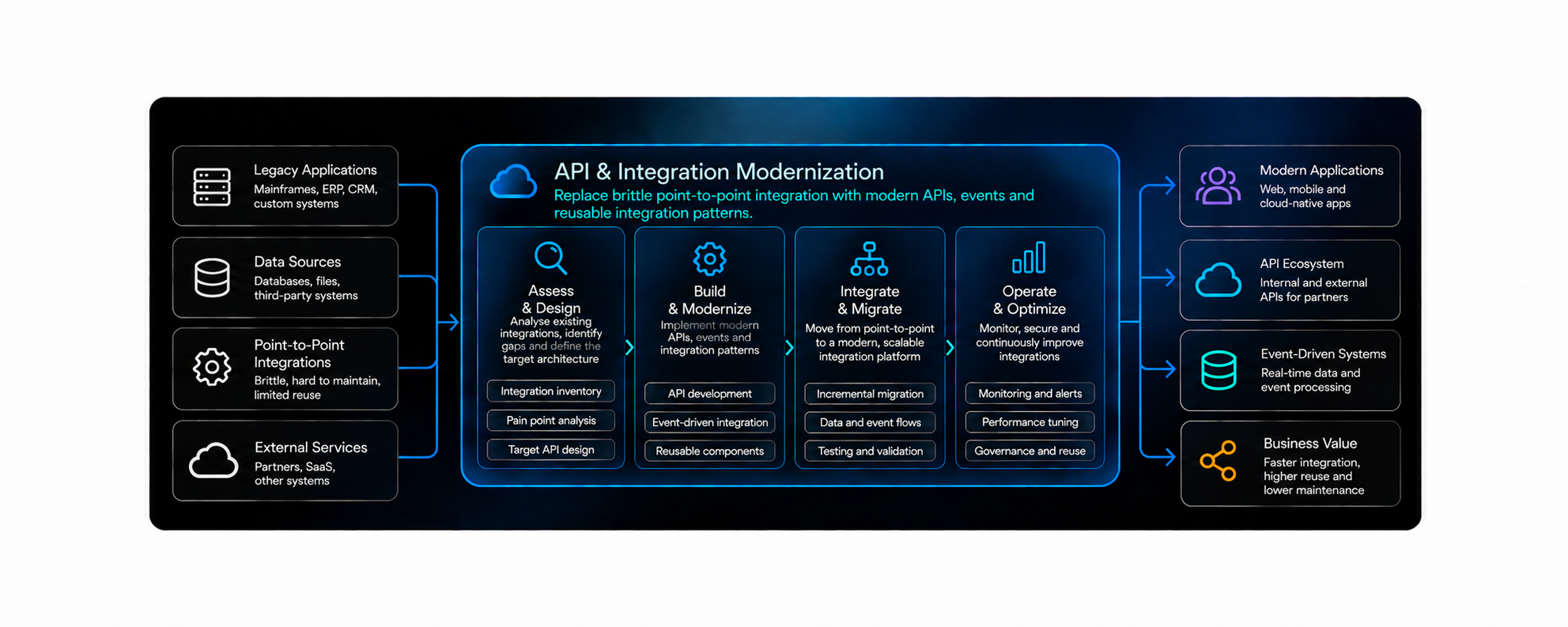
What does integration modernization include?
Modern integration separates applications from the internal details of the systems they depend on. APIs provide controlled access to services and data, while messaging and events allow systems to exchange information without requiring both sides to be available or tightly synchronized.
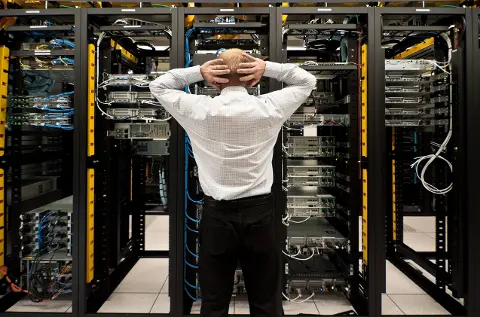
Modernize interfaces before replacing core systems
A critical legacy application does not always need to be rewritten before the rest of the business can move forward.
We can place stable APIs or integration layers around existing systems, move consumers to the new interfaces, and then modernize the underlying applications gradually.
This reduces the number of systems that have to change at the same time.
We provide:
API and integration architecture
Legacy interface modernization
Event and messaging patterns
API governance and migration planning

Benefits of API & Integration Modernization
Frequently Asked Questions
What is API and integration modernization?
API and integration modernization replaces fragile or outdated ways of connecting systems with clearer, reusable interfaces and integration patterns.
This can include REST APIs, messaging, events, workflow orchestration, API gateways and integration platforms.
The goal is not only newer technology. It is to reduce coupling between systems so future changes become easier to deliver and safer to operate.
Why are point-to-point integrations a problem?
A direct connection can be simple when only two systems are involved.
The problem appears as the environment grows. Each new application can create more custom interfaces, transformations, credentials and dependencies.
Changes then require coordination across many teams, and system knowledge becomes concentrated in a small number of specialists.
IBM and MuleSoft both describe reusable API-led integration as an alternative to this growing point-to-point complexity.
Do legacy applications have to be rewritten before we can expose APIs?
No.
An API can act as a controlled abstraction around an existing application or service.
This allows new consumers to use a stable interface even while the legacy backend remains in place.
Over time, parts of the backend can be modernized or replaced without forcing all consumers to change again.
Google, Microsoft and AWS all document this wrapper or abstraction approach for gradual modernization.
When should we use APIs and when should we use events?
Use APIs when a consumer needs a direct request and response, for example retrieving customer data or submitting an order.
Use events or messaging when systems should be less tightly connected, several consumers need the same business change, or processing can happen asynchronously.
For example, an order service may expose an API to create an order and publish an event after the order is accepted so billing, analytics and fulfilment can react independently.
Microsoft explicitly separates synchronous APIs from asynchronous queues and events in its integration guidance.
Can you modernize SOAP, ESB and older middleware integrations?
Yes.
Legacy integration can include SOAP services, proprietary ESBs, message brokers, batch interfaces, file transfers and custom application code.
We first identify consumers and contracts, then decide whether an interface should be wrapped, transformed, replaced or retired.
Where existing consumers cannot change immediately, compatibility can be maintained while newer consumers move to the modern interface.
AWS documents this exact problem for SOAP-to-REST modernization and recommends gradual compatibility rather than forcing every consumer to upgrade at once.
Does integration modernization require an iPaaS?
No.
An integration platform can be useful when many applications, SaaS products, APIs and workflows need common connectivity and governance.
But it should solve a real integration problem rather than become another platform that every system must depend on.
We can work with cloud-native services, API management platforms, message brokers, Kafka, iPaaS products or custom services depending on the estate and target architecture.
IBM also recommends hybrid integration patterns and unified integration platforms where fragmented scripts and custom interfaces have become difficult to scale.
How do you avoid creating another integration monolith?
We separate integration responsibilities and use clear ownership boundaries.
APIs should represent stable capabilities rather than expose every backend detail. Events should represent meaningful business changes. Orchestration should be used only where a process really needs central coordination.
We also define versioning, lifecycle and ownership so reusable assets do not become an unmanaged central dependency.
The goal is not to replace many point-to-point connections with one giant ESB.
Can this support a wider legacy modernization program?
Yes.
Modern integration is often one of the safest first steps in a larger modernization program.
APIs can isolate legacy systems, new services can be introduced behind stable interfaces, and events can allow old and new components to coexist.
This supports incremental patterns such as strangler fig, where functionality moves out of a legacy system gradually until the old implementation can eventually be retired. AWS Documentation
Turn your Technology Challenge into a clear Delivery Plan
Nubes Consulting Digital helps design, modernize and operate complex technology environments. From Cloud and Architecture to DevOps, SRE and Engineering Delivery, we focus on practical decisions, reliable execution and measurable business outcomes.
