
Service
Cloud-to-Cloud Migration
Move workloads between AWS, Azure, OCI and other providers while managing service dependencies and data transfer.


Change cloud provider without breaking the workload
Moving between cloud providers means more than copying virtual machines and data.
We migrate applications and infrastructure between AWS, Azure, Google Cloud, OCI and other cloud platforms while managing service differences, dependencies, data transfer, security and production cutover.
Typical scenarios:
Cloud strategy is changing – move workloads to a provider that better fits current business and technical requirements.
Platforms need consolidation – reduce duplicated cloud estates after acquisitions, restructuring or decentralized adoption.
Cost or contract pressure – move workloads when commercial conditions no longer support the current platform.
Data, sovereignty or resilience requirements change – place workloads where regulatory, operational or availability needs can be met.
How does Cloud-to-Cloud Migration work?
We map the source workload to the target cloud, rebuild the required platform services, synchronize data and move production traffic through a controlled and tested cutover.
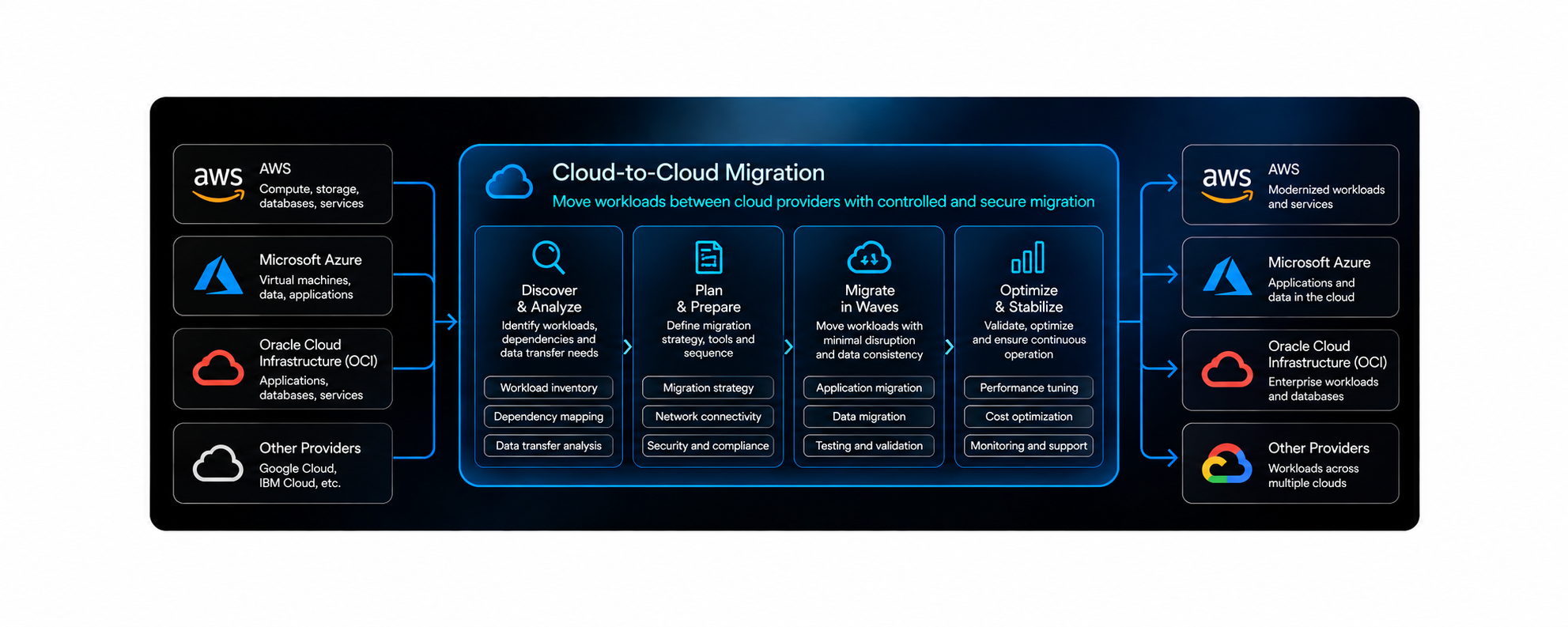
What does a cloud-to-cloud migration include?
Cloud providers solve similar problems in different ways. A successful migration must translate the complete workload across compute, data, networking, identity, security and operations rather than assume that source services have exact equivalents.
Translate the architecture, not just the infrastructure
There is rarely a perfect one-to-one mapping between cloud providers.
We preserve workload requirements while selecting the right target services, rebuilding infrastructure as code and adapting integrations, deployment pipelines and operations where needed.
The goal is not to recreate every source-cloud decision unchanged. It is to make the workload work correctly on the new platform.
We provide:
Source-to-target service mapping
Target infrastructure and IaC implementation
Data migration and synchronization
Cutover, rollback and source-cloud exit

Benefits of Cloud-to-Cloud Migration
Frequently Asked Questions
What is a cloud-to-cloud migration?
Cloud-to-cloud migration moves applications, data and supporting infrastructure from one cloud provider to another.
For example, this can mean AWS to Azure, Azure to Google Cloud, OCI to AWS, or movement between regional and sovereign cloud providers.
The migration can involve compute, databases, storage, networking, identity, security, CI/CD and operational tooling.
Which cloud providers can you migrate between?
We are cloud agnostic.
We work across AWS, Microsoft Azure, Google Cloud, Oracle Cloud Infrastructure and other public, regional and sovereign cloud platforms.
The migration design is based on the actual source and target environments rather than a fixed provider-specific method.
OCI itself now supports discovery and migration of AWS EC2 workloads into OCI, while Microsoft and Google publish dedicated migration guidance for workloads coming from competing public clouds.
Can cloud services be mapped directly between providers?
Sometimes, but not always.
Virtual machines, object storage and basic networking often have clear target equivalents. Managed databases, identity services, serverless platforms, queues, analytics and provider-specific APIs may require a more careful redesign.
We identify those differences before migration and decide whether to use an equivalent service, keep part of the workload unchanged or replatform selected components.
How do you migrate large amounts of data between clouds?
The approach depends on data volume, change rate, network capacity and acceptable downtime.
A common pattern is to perform an initial bulk transfer and then keep source and target synchronized until final cutover.
For workloads with tight RPO requirements, continuous replication may be required. For less dynamic data, backup-and-restore or batch transfer can be simpler.
Microsoft specifically recommends choosing live replication or offline migration based on RPO and data requirements rather than using one transfer method for every workload.
What about cloud data-transfer and egress costs?
They need to be included in the migration plan.
Large cloud-to-cloud migrations can generate temporary costs for data transfer, duplicate environments, replication infrastructure and parallel operations.
We estimate these transition costs alongside target infrastructure cost so the business case reflects the migration period—not only the steady-state cloud bill.
This also aligns with the Nubes research principle that transition, egress and dual-running costs should be included in infrastructure decisions rather than hidden outside the TCO.
How do you minimize downtime?
We prepare and test the target environment before the production switch.
Where possible, data is synchronized continuously, dependencies are tested from both environments and production traffic is moved only after health checks succeed.
DNS, load balancers or application routing can then direct users to the new platform.
For critical workloads, we define maintenance windows, success criteria and rollback conditions before cutover. Microsoft’s current cross-cloud guidance recommends this same pattern and specifically warns against rushing testing or validation.
Can source and target clouds run together during migration?
Yes, and this is common in phased migrations.
Some application components may move before others, which means dependencies must continue to work across both providers for a period of time.
We plan temporary cross-cloud connectivity, routing, security and data synchronization so this coexistence is deliberate rather than accidental.
Microsoft explicitly notes that during phased migration, some dependencies may remain in the source cloud while migrated components already run in the target environment.
When can we switch off the source cloud?
Only after the workload is validated in the target environment.
We check application function, integrations, data consistency, monitoring, backup, security and operational readiness before source resources are retired.
The decommissioning plan should also remove temporary connectivity, replication and duplicate services that were needed only during migration.
Turn your Technology Challenge into a clear Delivery Plan
Nubes Consulting Digital helps design, modernize and operate complex technology environments. From Cloud and Architecture to DevOps, SRE and Engineering Delivery, we focus on practical decisions, reliable execution and measurable business outcomes.
