
Service
Migration Recovery & Assurance
Discover powerful data management platforms and services. Enhance your enterprise data platform, streamline analytics, and drive smarter business decisions.


Get a stalled migration moving again
Cloud migration programs rarely fail because one migration tool stops working. More often, dependencies remain unresolved, waves are not ready, decisions take too long and delivery teams keep working around the same blockers.
We provide independent technical assurance and recovery leadership to identify what is stopping progress, reset migration controls and restore a reliable path to production.
Typical scenarios:
Migration waves have stalled – teams are active, but workloads are not reaching production.
Cutovers keep slipping or rolling back – readiness, testing or dependencies are not under control.
Costs are growing faster than progress – source and target environments keep running while migration dates move.
Executive confidence is falling – reporting shows activity, but nobody can clearly explain the constraint or recovery plan.
How does Migration Recovery & Assurance work?
We build an independent fact base, identify the real delivery constraint, reset wave and cutover controls, and use one recoverable migration wave to prove the new approach.
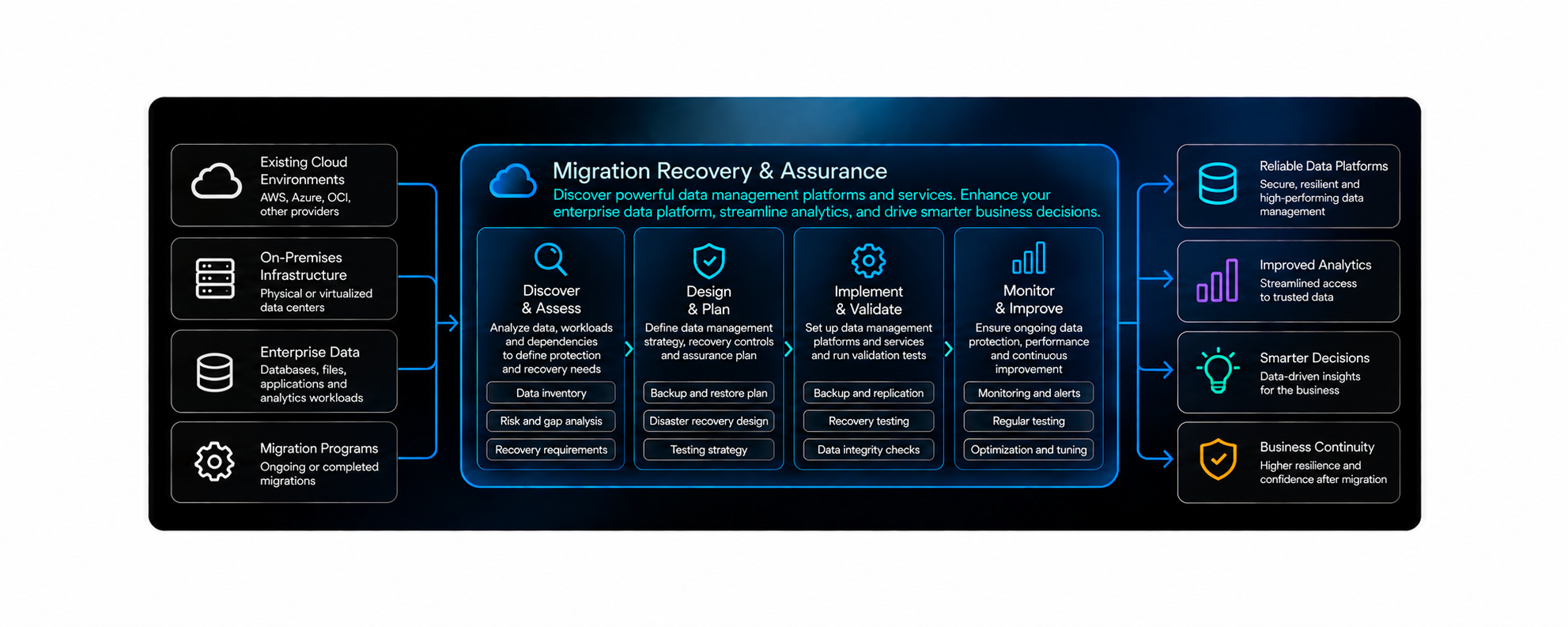
What does migration recovery cover?
Recovery starts by separating symptoms from causes. Delayed waves, failed tests and missed cutovers may come from architecture, dependencies, governance, unclear ownership, platform readiness or unrealistic planning. We identify the constraint before adding more people or activity.

Fix the constraint before adding more capacity
When a migration falls behind, the natural response is often to add engineers, create more meetings or run more waves in parallel.
That only helps when capacity is the real problem.
We identify what is limiting delivery, stop work that cannot pass clear readiness gates, and rebuild a migration flow that teams can execute repeatedly.
We provide:
Migration program health assessment
Dependency and blocker analysis
Wave and governance reset
Cutover assurance and recovery control

Benefits of Migration Recovery & Assurance
Frequently Asked Questions
What is migration recovery?
Migration recovery is a structured intervention for a cloud migration program that is stalled, repeatedly missing waves or no longer delivering the expected business outcome.
We assess the migration pipeline, dependencies, architecture, governance, defects and decision process to identify the main constraint.
The objective is not another status review. It is a practical recovery plan that can be tested through a real migration wave.
How is migration assurance different from migration delivery?
Migration delivery performs the migration work.
Migration assurance independently checks whether the program is ready to execute safely and predictably.
This can include reviewing architecture, wave plans, dependencies, test evidence, rollback, cutover readiness and governance while your existing internal teams or implementation partners continue delivery.
Capgemini, for example, describes migration assurance as working across application partners to validate and drive completion of the wider migration program rather than replacing every delivery team.
Do you replace our existing migration partner?
Not necessarily.
In many programs, the implementation teams already have useful knowledge and technical capacity.
Nubes can work as an independent architecture and assurance layer: clarify blockers, challenge assumptions, reset governance and help existing teams execute against clearer gates.
If a delivery workstream genuinely needs replacement or additional specialists, that decision can be made after the root cause is understood.
How do you identify why a migration is stalled?
We start from evidence rather than existing status reports.
Typical inputs include wave plans, dependency maps, architecture decisions, defect data, failed cutovers, change records, program risks, decision backlogs, cloud readiness and interviews with application and platform owners.
We then look for the constraint that repeatedly stops workloads from progressing.
AWS recommends transparent tracking across migration workstreams because portfolio, platform, governance and migration teams operate at the same time and problems in one can block the whole pipeline.
Can you recover a migration without stopping the whole program?
Usually, yes.
We do not recommend pausing productive work simply because an assessment is taking place.
Healthy waves can continue. Workloads that cannot pass explicit readiness criteria may be stopped or resequenced until their blockers are resolved.
The aim is to protect useful delivery while preventing more risk from entering the pipeline.
What do you review before a migration cutover?
We review the items that determine whether production can move safely.
This can include technical readiness, data synchronization, application testing, monitoring, security, stakeholder availability, communication, success criteria, rollback and operational support.
Google recommends a risk assessment for every migration wave and a rollback strategy for each migration step. AWS similarly treats the cutover as one of the highest-risk points in migration and recommends explicit governance and communication around it.
What happens after the recovery assessment?
We normally create a rebaselined migration plan with clear priorities, owners, gates and decision points.
Rather than declaring the program “recovered” from a report, we recommend validating the new model through one representative migration wave.
Actual execution then shows whether the architecture, governance and operational changes work.
Microsoft recommends the same iterative principle: use milestones and actual wave results to adjust later migration plans rather than continuing with assumptions that execution has already disproved.
What do we receive from a Migration Recovery & Assurance engagement?
The exact deliverables depend on the program, but typically include a migration health fact base, constraint and dependency map, rebaselined wave plan, readiness and cutover gates, decision and responsibility model, recovery risks and an executive recovery plan.
For ongoing programs, Nubes can continue as an independent migration assurance or control function through critical migration waves.
Turn your Technology Challenge into a clear Delivery Plan
Nubes Consulting Digital helps design, modernize and operate complex technology environments. From Cloud and Architecture to DevOps, SRE and Engineering Delivery, we focus on practical decisions, reliable execution and measurable business outcomes.
